
India’s logistics sector is undergoing a remarkable transformation, driven by rapid industrialization, expanding manufacturing capabilities, rising exports, booming e-commerce, and significant investments in transportation infrastructure. Freight forwarding hubs have become an essential part of the country’s supply chain ecosystem, connecting manufacturers, exporters, importers, ports, airports, rail networks, and distribution centers. As businesses increasingly seek efficient multimodal logistics solutions, strategically located freight forwarding hubs are witnessing strong demand across major industrial and trade corridors.
Government initiatives such as the PM Gati Shakti National Master Plan, National Logistics Policy (NLP), Dedicated Freight Corridors (DFC), Bharatmala, Sagarmala, and increasing private investments in warehousing and logistics parks are creating significant opportunities for investors looking to establish modern freight forwarding hubs in India. However, selecting the right location, understanding cargo demand, evaluating competition, complying with regulations, and estimating project profitability require detailed market research and feasibility analysis.
These trends highlight why conducting a Feasibility Study for Freight Forwarding Hubs has become an essential first step before investing in logistics infrastructure.
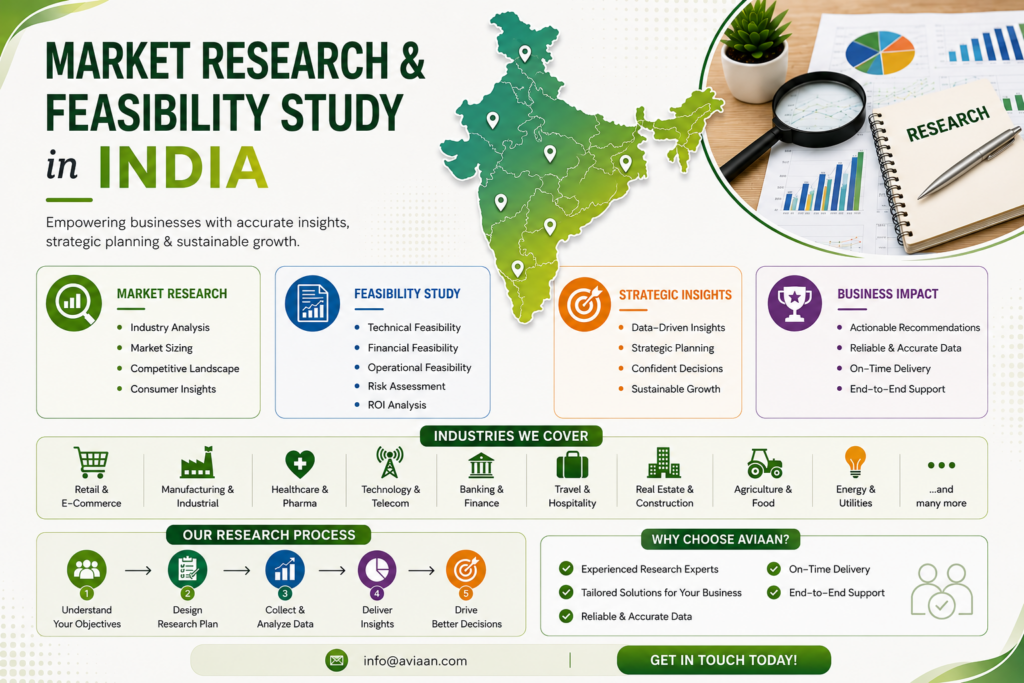
Aviaan supports investors, logistics companies, developers, and entrepreneurs with comprehensive Market Research, Feasibility Studies, Business Plans, Financial Modeling, Business Valuation, and Strategic Advisory Services tailored specifically for freight forwarding hubs across India. Our research-driven approach helps clients make confident investment decisions while minimizing project risks.
Thinking of investing in a freight forwarding hub? Connect with Aviaan for a customized feasibility study designed for your business goals.
The Indian freight forwarding and logistics sector continues to evolve rapidly due to infrastructure development, international trade, and digital supply chain transformation. Below are key industry statistics that demonstrate the sector’s growth potential.
These developments indicate a favorable investment climate for professionally planned freight forwarding hubs supported by comprehensive market research and feasibility analysis.
Need location-specific market intelligence? Speak with Aviaan’s consultants for data-backed insights tailored to your investment strategy.
Developing a freight forwarding hub involves substantial investments in land acquisition, infrastructure, technology, fleet integration, warehousing facilities, customs coordination, and workforce development. Without a comprehensive feasibility study, businesses may underestimate cargo demand, overestimate revenue potential, or select locations that lack long-term commercial viability.
A professional feasibility study evaluates regional trade flows, industrial clusters, cargo volumes, transportation connectivity, customer demand, competitor positioning, and regulatory requirements. It helps investors understand whether a proposed location can generate sustainable freight movement while supporting efficient multimodal transportation.
The study also examines infrastructure availability, proximity to ports, airports, rail terminals, highways, manufacturing zones, and export-oriented industries. Financial analysis includes capital expenditure estimates, operating costs, revenue projections, profitability analysis, break-even assessment, sensitivity analysis, and investment returns under multiple market scenarios.
In addition, businesses gain insights into evolving logistics technologies, sustainability requirements, customs regulations, and market risks that may affect long-term operations. These findings enable informed decision-making, reduce uncertainty, and improve investor confidence.
Whether the project involves an independent freight forwarding facility, an integrated logistics park, or a multimodal cargo hub, a professionally prepared feasibility study provides the strategic foundation required for successful execution and long-term profitability.
Planning a logistics investment? Let Aviaan prepare a customized feasibility study that supports confident, data-driven decisions.
Aviaan provides end-to-end consulting solutions for businesses planning, expanding, or investing in freight forwarding hubs throughout India. Our multidisciplinary team combines market intelligence, financial expertise, and industry knowledge to evaluate commercial opportunities across the logistics value chain.
Our market research identifies demand drivers, cargo movement patterns, customer segments, industry growth trends, regional trade opportunities, and competitor analysis. We evaluate ideal project locations based on infrastructure connectivity, industrial activity, transportation networks, and future development plans.
Our feasibility studies assess technical viability, operational requirements, investment feasibility, financial projections, profitability analysis, break-even timelines, risk assessment, and regulatory considerations. We also develop comprehensive business plans that support financing discussions with banks, investors, private equity firms, and strategic partners.
In addition, Aviaan prepares robust financial models, conducts business valuation, commercial due diligence, investment analysis, and strategic advisory services that help businesses optimize capital allocation and improve long-term returns.
Our objective is not just to assess whether a project is feasible but to identify practical strategies that improve commercial success while minimizing investment risk.
Ready to evaluate your freight forwarding hub opportunity? Contact Aviaan today to discuss your project with our market research and feasibility specialists
A successful freight forwarding hub requires more than modern infrastructure—it needs a well-planned market entry strategy. Businesses should first identify their target customers, including exporters, importers, manufacturers, e-commerce companies, third-party logistics (3PL) providers, and freight brokers. Pricing should remain competitive while emphasizing value-added services such as customs clearance, multimodal transportation, cargo tracking, warehousing, and last-mile connectivity.
Building strategic partnerships with shipping lines, airlines, transport operators, customs agents, warehouse providers, and industrial parks can strengthen service capabilities. Digital marketing, industry networking, trade exhibitions, and direct B2B sales play a crucial role in acquiring clients. Continuous monitoring of customer needs and operational performance helps maintain long-term competitiveness.
Looking to launch or expand a freight forwarding hub? Speak with Aviaan to develop a customized go-to-market strategy aligned with your business objectives.
A logistics investor plans to establish a freight forwarding hub near the Delhi–Mumbai Industrial Corridor (DMIC). Before proceeding, a feasibility study identifies strong demand from automotive, engineering, pharmaceutical, and FMCG manufacturers. However, it also reveals intense competition within a 30-kilometer radius.
Based on market research, the investor decides to differentiate by offering integrated warehousing, customs clearance, temperature-controlled cargo handling, and digital shipment tracking. Financial modeling confirms that the revised business model improves profitability while reducing investment risks and achieving a faster payback period.
Whether your project is located near a port, airport, industrial corridor, or manufacturing cluster, Aviaan can help you validate opportunities before significant capital is invested.
Aviaan has supported logistics, transportation, and supply chain businesses across India with market research, feasibility studies, business planning, financial modeling, and investment advisory. Our consulting assignments are designed to help clients make informed decisions, optimize investments, and build commercially sustainable freight forwarding operations.
Partner with Aviaan to leverage practical consulting expertise that supports smarter investments and sustainable business growth.
Reliable business decisions require more than published industry reports. At Aviaan, we combine extensive primary research with credible secondary research to provide accurate, actionable, and localized insights for freight forwarding hub projects across India. This integrated approach helps investors understand real market demand, customer expectations, operational challenges, and competitive dynamics before making major investment decisions.
Our research methodology includes:
This rigorous research process strengthens demand forecasting, validates investment assumptions, improves financial projections, and supports informed decision-making.
Need reliable market intelligence for your logistics investment? Connect with Aviaan to receive research-backed insights tailored to your project.
India’s freight forwarding industry is entering a new phase of growth, driven by expanding trade, modern infrastructure, digital logistics, manufacturing growth, and government initiatives such as the National Logistics Policy and PM Gati Shakti. These developments present significant opportunities for investors, logistics operators, and developers planning new freight forwarding hubs.
However, the success of any logistics project depends on selecting the right location, understanding regional demand, evaluating competitors, assessing operational requirements, and preparing realistic financial projections. A comprehensive Feasibility Study for Freight Forwarding Hubs provides the insights needed to reduce risks, optimize investments, and build a profitable business.
With expertise in Market Research, Feasibility Studies, Business Plans, Financial Modeling, Business Valuation, Commercial Due Diligence, and Business Advisory, Aviaan helps businesses make confident, data-driven investment decisions across India’s evolving logistics sector.
Planning a freight forwarding hub in India? Contact Aviaan today to discuss your project and receive a customized market research and feasibility study tailored to your investment goals.
A feasibility study evaluates the commercial, operational, technical, and financial viability of establishing a freight forwarding hub. It assesses market demand, location suitability, infrastructure, competition, regulatory requirements, investment costs, revenue potential, and project risks.
Market research helps investors understand customer demand, cargo volumes, industry trends, competitor strategies, pricing, and regional trade opportunities. It minimizes uncertainty and supports informed investment decisions.
Aviaan’s feasibility studies typically include market analysis, demand estimation, competitor assessment, location analysis, financial projections, profitability analysis, operational planning, risk assessment, business planning, and strategic recommendations.
Suitable locations depend on the target market and cargo type. Major logistics destinations include Mumbai, Delhi NCR, Chennai, Hyderabad, Bengaluru, Pune, Ahmedabad, Kolkata, Visakhapatnam, and industrial corridors connected through ports, airports, rail terminals, and highways.
Potential investors include logistics companies, freight forwarding firms, warehouse developers, infrastructure companies, industrial park developers, private equity firms, transportation businesses, exporters, and entrepreneurs looking to enter the logistics sector.
Related Posts
Market Research and Feasibility Study for Training Institutes in India
Market Research and Feasibility Study for EdTech Campuses in India
Market Research and Feasibility Study for Student Accommodation in India
Market Research and Feasibility Study for Research Centers in India
Market Research Feasibility Study for Retail Consumer in India
Market Research and Feasibility Study for Shopping Malls in India
Market Research and Feasibility Study for Hypermarkets in India
Market Research Feasibility Study for E-commerce Fulfillment Centers in India
Market Research and Feasibility Study for Logistics & Supply Chain in India
Market Research and Feasibility Study for Cold Storage in India
Market Research and Feasibility Study for Distribution Centers in India
Market Research and Feasibility Study for Refineries in India
Market Research and Feasibility Study for Ports in India
Market Research and Feasibility Study for Agriculture & Food in India
Market Research and Feasibility Study for Dairy Farms in India