


Australia has a highly developed maritime economy and an extensive coastline that supports international trade, domestic transportation, resource exports, and regional logistics. Consequently, ports play a critical role in connecting Australia's mining, energy, agriculture, manufacturing, retail, and consumer sectors with domestic and international markets.
Australian ports handle a broad range of cargo, including iron ore, coal, LNG, agricultural commodities, containers, petroleum products, chemicals, vehicles, machinery, construction materials, and general cargo. Furthermore, the diversity of cargo creates opportunities for different types of port infrastructure and specialised terminals.
Australia's mining and natural resources industries are major drivers of port demand. In particular, iron ore, coal, LNG, and other minerals require specialised terminals, bulk-handling infrastructure, storage facilities, rail connections, and efficient vessel operations.
Furthermore, Australia's energy transition is creating new opportunities for port infrastructure. Critical minerals, hydrogen, renewable energy equipment, battery materials, offshore wind components, and other clean-energy supply chains may require specialised terminals, storage facilities, heavy-load handling capabilities, and new logistics connections.
Port automation, digitalisation, decarbonisation, shore-side infrastructure, terminal expansion, intermodal logistics, and green shipping initiatives can therefore create opportunities for infrastructure developers, logistics operators, shipping companies, energy businesses, and private investors.
However, port projects in Australia require significant capital investment and detailed regulatory, environmental, technical, and financial planning. Investors must consequently evaluate cargo demand, vessel traffic, site suitability, infrastructure requirements, environmental considerations, land access, rail and road connectivity, competition, operating costs, and expected financial returns.
Therefore, conducting a professional Port Feasibility Study for Australia is essential before developing new port facilities, expanding existing terminals, or investing in maritime infrastructure.
Connect with Aviaan to evaluate your port investment using reliable market intelligence and financial analysis.

Australia's latest official trade data continues to demonstrate the importance of major resource commodities to the country's international trade. For example, the Australian Bureau of Statistics reported that in April 2026, export quantities of iron ore lump increased 15.8% year-on-year, while iron ore fines increased 6.4%. During the same period, hard coking coal increased 28.9%, semi-soft coal increased 29.1%, and thermal coal increased 6.5% year-on-year. LNG export quantity, meanwhile, decreased 6.2% year-on-year.
Based on these current trade indicators, several factors are relevant to port feasibility planning:
Need Australia port market intelligence? Contact Aviaan for a customised port feasibility study and investment analysis.
Developing a commercial port, cargo terminal, logistics hub, or marine infrastructure project requires significant investment in berths, dredging, cargo-handling equipment, storage facilities, utilities, transportation connections, and supporting infrastructure.
Therefore, investors need to understand whether the proposed project can generate sufficient cargo volumes and revenues to justify the required capital investment.
Australia's vast geography and resource-intensive economy make location, cargo catchment, rail connectivity, road access, and proximity to production centres particularly important. Furthermore, the feasibility of a port can vary considerably depending on its target cargo, regional industry base, vessel requirements, and access to existing infrastructure.
Without proper feasibility analysis, investors may face challenges related to cargo demand, construction costs, environmental approvals, operating expenses, regulatory requirements, competition, financing, and project timelines.
A professional feasibility study helps investors evaluate:
A detailed study can identify opportunities across:
Moreover, specialised terminals may provide opportunities where cargo requirements are sufficiently strong and infrastructure can be designed around specific industries.
For example, mining-linked ports may require high-capacity bulk handling systems, dedicated rail connections, stockyards, conveyor systems, and specialised loading equipment. Similarly, container terminals may require cranes, automated handling systems, container yards, customs facilities, warehouses, and efficient road and rail access.
Financial analysis is another essential component of a port feasibility study. In particular, investors need to understand the relationship between initial capital expenditure, operating costs, cargo volumes, pricing, revenue growth, and expected returns.
The financial assessment includes:
Furthermore, scenario analysis can help investors understand how changes in cargo volumes, tariffs, construction costs, operating expenses, interest rates, or project timelines could affect financial performance.
As a result, a detailed financial model provides investors with a clearer view of funding requirements, expected returns, downside risks, and long-term project sustainability.
A port cannot be evaluated in isolation. Instead, its success depends on how efficiently it connects with the wider logistics network.
Therefore, the feasibility study should assess:
Furthermore, efficient hinterland connectivity can reduce truck congestion, improve cargo turnaround times, lower transportation costs, and strengthen the commercial attractiveness of a port.
Environmental and regulatory factors are particularly important for major Australian infrastructure projects. Consequently, investors need to assess potential impacts relating to marine ecosystems, dredging, coastal areas, emissions, biodiversity, land use, noise, water quality, and community considerations.
In addition, regulatory approvals and compliance requirements can influence project costs and timelines. Therefore, these factors should be considered during the feasibility stage rather than after major investment decisions have already been made.
A port project involves long development timelines and substantial financial commitments. For this reason, early-stage feasibility analysis can help investors identify potential problems before committing significant capital.
A professional feasibility study can consequently help businesses:
Ultimately, research-driven planning enables investors to develop competitive port infrastructure that supports Australia's mining, energy, agriculture, manufacturing, logistics, critical minerals, renewable energy, consumer, and international trade sectors.
Discuss your Australia port project with Aviaan's feasibility specialists and receive a customised feasibility study designed for your investment objectives.
Developing a successful port project requires detailed market intelligence, cargo demand assessment, infrastructure planning, financial analysis, and regulatory evaluation. Therefore, Aviaan helps investors, port developers, logistics companies, EPC contractors, government authorities, shipping companies, and infrastructure funds make informed investment decisions through research-driven consulting services.
Our team provides customised solutions for port development projects across Australia. From the initial project concept to site evaluation, investment planning, and expansion strategy, we support clients throughout the development process.
Aviaan conducts comprehensive Market Research to understand cargo demand, maritime trade flows, shipping trends, logistics requirements, competitive positioning, and long-term investment opportunities.
Our research covers:
Furthermore, we assess opportunities across container terminals, deep-water ports, bulk cargo facilities, iron ore terminals, coal terminals, LNG terminals, petroleum facilities, agricultural and grain terminals, critical minerals terminals, Ro-Ro facilities, industrial ports, cold-chain logistics facilities, logistics parks, warehousing facilities, and multi-purpose commercial ports.
As a result, investors receive a clearer understanding of the market opportunity and the cargo segments most likely to support long-term port utilisation.
Our Port Feasibility Study for Australia evaluates technical, commercial, operational, environmental, and financial factors before major investments.
The study includes:
Moreover, the study can compare alternative development scenarios to determine which option provides the strongest commercial and operational potential.
The objective is therefore to identify investment opportunities, infrastructure requirements, project risks, and long-term commercial viability before significant capital is committed.
Aviaan prepares investor-ready financial models for port infrastructure projects.
Our financial analysis includes:
Furthermore, scenario analysis can assess how changes in cargo volumes, tariffs, construction costs, operating expenses, financing costs, and project timelines could affect overall financial performance.
As a result, investors can better understand funding requirements, potential returns, downside risks, and long-term project sustainability.
A port's commercial success depends not only on marine infrastructure but also on its connection with the wider logistics network.
Therefore, Aviaan evaluates:
In particular, Australia's large geographic area makes efficient rail and road connectivity especially important. Consequently, infrastructure planning must consider both the port and its wider supply-chain ecosystem.
Environmental and regulatory considerations can significantly influence port development costs, timelines, and operational requirements.
Therefore, our feasibility studies consider:
By identifying these factors early, investors can reduce the possibility of unexpected delays and additional costs during later stages of development.
Moreover, our approach integrates market, operational, infrastructure, financial, and strategic analysis rather than evaluating each component independently.
Our goal is to help investors reduce project risks and develop commercially successful port infrastructure.
Planning a port project in Australia? Connect with Aviaan for a customised feasibility study and strategic investment advisory services.
A successful port development requires strong cargo generation, efficient infrastructure, strategic partnerships, and excellent operational capabilities. Therefore, a well-designed Go-to-Market Strategy should be developed alongside the feasibility study.
Port developers should target:
Furthermore, cargo diversification can reduce dependence on a single industry and potentially improve long-term port resilience.
To build a strong competitive position, projects should focus on:
In addition, digital systems can improve cargo visibility, operational planning, asset utilisation, documentation, and communication between port stakeholders.
Strategic partnerships can significantly strengthen cargo generation and customer acquisition.
Potential partners include:
For example, long-term agreements with major cargo owners can provide greater revenue visibility. Similarly, partnerships with logistics providers can improve access to downstream customers.
Marketing efforts should include direct engagement with shipping lines and major cargo owners, participation in maritime and logistics events, trade promotion initiatives, industry networking, and collaboration with relevant associations.
Moreover, a strong digital presence can support business development by presenting the port's infrastructure capabilities, cargo-handling capacity, connectivity, sustainability initiatives, and value-added logistics services.
As a result, an integrated go-to-market strategy can help build cargo volumes, attract anchor customers, and strengthen long-term commercial performance.
Ready to develop a port project in Australia? Talk to Aviaan for a customised go-to-market strategy.
Aviaan has supported infrastructure, logistics, transportation, and industrial projects through market research, feasibility studies, financial modelling, and strategic advisory services.
Our experience includes:
Furthermore, this experience enables Aviaan to understand the interconnected nature of port infrastructure, logistics, cargo generation, financial planning, and investment strategy.
Aviaan helps governments, developers, investors, and logistics companies transform port development opportunities into sustainable and profitable infrastructure projects.
Partner with Aviaan to develop successful port projects in Australia through research-backed insights and strategic advisory services.
Successful port developments require accurate market intelligence, cargo demand forecasting, maritime trade analysis, infrastructure planning, and financial evaluation. Therefore, Aviaan combines detailed Primary Research with reliable secondary research to deliver comprehensive Port Feasibility Studies for investors, infrastructure developers, logistics companies, government authorities, and port operators across Australia.
Moreover, our research approach helps investors understand cargo flows, shipping trends, resource export opportunities, competitive positioning, infrastructure requirements, operational challenges, environmental considerations, and long-term commercial viability before making major investment decisions.
Furthermore, this research methodology improves:
As a result, businesses can reduce commercial, operational, financial, environmental, and regulatory risks while improving long-term project viability.
Looking for reliable port market intelligence in Australia? Connect with Aviaan for a customised Port Feasibility Study supported by comprehensive primary research.
Australia's extensive coastline, strong resource-export economy, developed logistics infrastructure, and growing renewable energy and critical minerals sectors create significant opportunities for port and maritime infrastructure investment.
In particular, the country's mining, iron ore, coal, LNG, agriculture, manufacturing, critical minerals, renewable energy, and consumer industries support opportunities across bulk cargo terminals, container terminals, deep-water ports, specialised terminals, Ro-Ro facilities, logistics hubs, cold-chain infrastructure, warehousing, and multimodal transportation infrastructure.
Furthermore, Australia's large geographic size makes efficient rail and road connectivity particularly important. Therefore, port projects that integrate maritime facilities with mining regions, industrial centres, warehouses, highways, rail networks, and distribution hubs can improve supply-chain efficiency and strengthen commercial competitiveness.
The energy transition also creates emerging opportunities. For example, critical minerals, hydrogen, renewable energy equipment, offshore wind components, battery materials, and other clean-energy supply chains may generate new demand for specialised port infrastructure.
However, these opportunities also involve considerable investment and operational risks. Consequently, investors should evaluate cargo demand, shipping trends, resource production, location suitability, infrastructure requirements, environmental considerations, regulatory approvals, operating costs, financial performance, and competitive positioning before committing significant capital.
A professional Port Feasibility Study for Australia enables investors to assess market opportunities, estimate project costs, evaluate financial returns, identify risks, and develop sustainable investment strategies before project execution.
Moreover, feasibility analysis can help investors compare different locations, cargo segments, infrastructure configurations, operating models, and expansion scenarios. As a result, decision-makers can select an investment structure that better aligns with their commercial objectives.
With comprehensive planning and market-driven decision-making, investors can develop efficient port infrastructure that supports Australia's mining, energy, agriculture, manufacturing, logistics, critical minerals, renewable energy, consumer, and international trade sectors.
Aviaan provides comprehensive Port Feasibility Studies, Market Research, Business Plans, Financial Modelling, Business Valuation, Commercial Due Diligence, Investment Advisory, and Business Strategy services for port and maritime infrastructure projects across Australia.
Furthermore, our research-driven approach helps infrastructure developers, logistics companies, port operators, government agencies, and investors make confident investment decisions while reducing project risks.
Ready to develop a successful port project in Australia? Contact Aviaan today for a customised Port Feasibility Study designed specifically for your investment objectives.
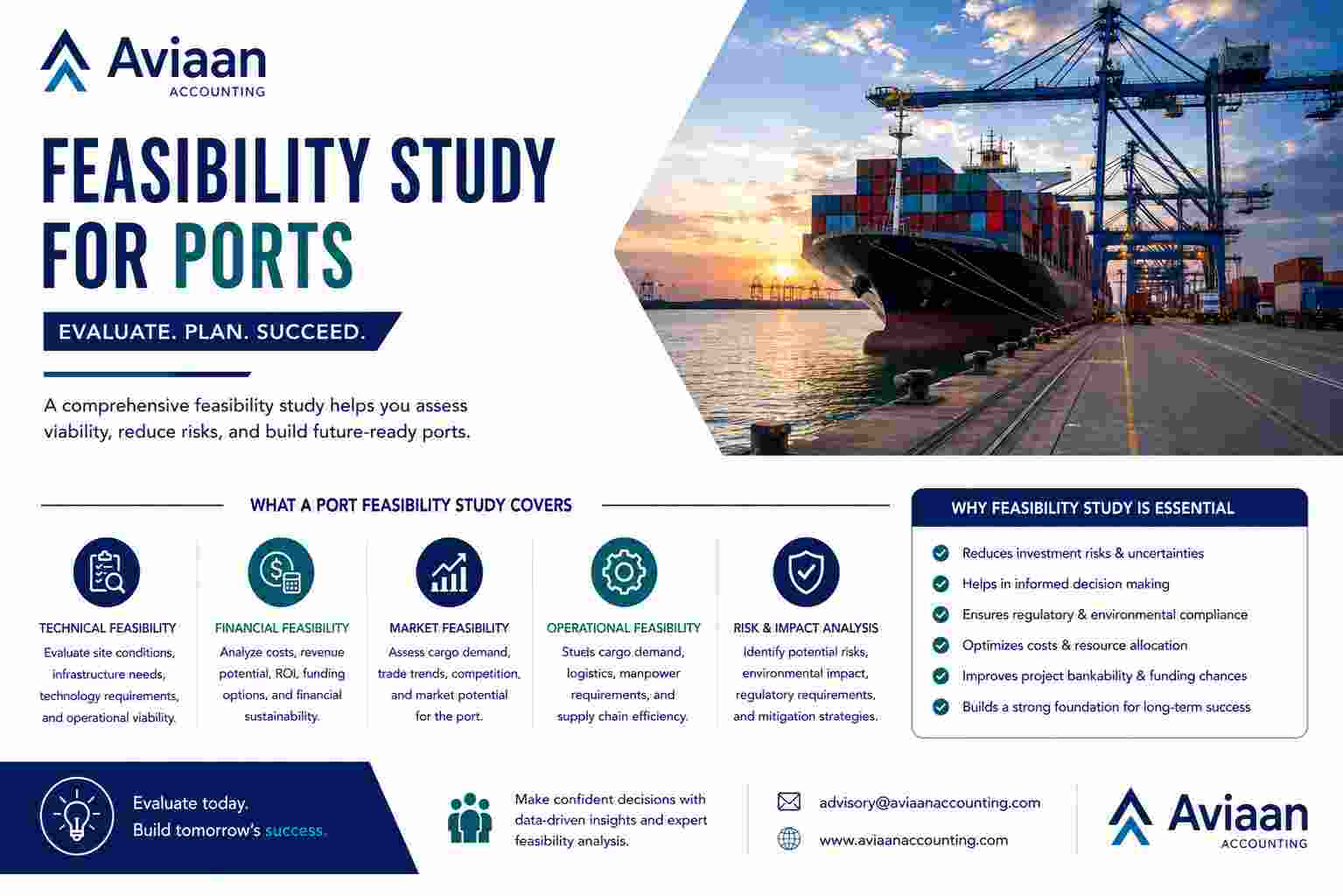
A Port Feasibility Study evaluates the commercial, technical, operational, environmental, and financial viability of developing or expanding a port. Therefore, it helps investors understand cargo demand, infrastructure requirements, investment costs, risks, and expected returns before starting a project.
Australia's strong resource-export economy, extensive coastline, mining industry, agricultural production, manufacturing sector, critical minerals opportunities, and renewable energy development create significant opportunities for port investments.
However, each project has different market and infrastructure requirements. Therefore, a feasibility study helps investors assess cargo potential, logistics demand, competition, regulatory requirements, environmental considerations, and long-term commercial viability.
Aviaan provides market research, cargo demand analysis, shipping and trade assessment, resource and industrial cargo analysis, site evaluation, infrastructure planning, competitor benchmarking, financial modelling, environmental considerations, risk analysis, and investment recommendations.
Furthermore, the study can compare alternative development scenarios so investors can identify the most commercially attractive option.
Infrastructure developers, port operators, logistics companies, government authorities, mining companies, industrial developers, EPC contractors, investment funds, shipping companies, energy businesses, and financial institutions can benefit from a professional Port Feasibility Study.
In addition, businesses entering Australia's critical minerals and renewable energy supply chains can use feasibility analysis to evaluate specialised port and logistics requirements.
Yes. Aviaan develops investor-ready financial models covering capital expenditure, operating costs, cargo revenue forecasts, profitability analysis, cash flow projections, break-even analysis, sensitivity analysis, and return on investment.
Moreover, scenario and sensitivity analysis can show how changes in cargo volumes, tariffs, costs, financing, or project timelines may affect overall financial performance.
Aviaan combines expertise in infrastructure consulting, logistics, maritime trade, market research, financial analysis, and strategic advisory to deliver practical, data-driven feasibility studies.
Therefore, our customised approach helps clients reduce investment risks, strengthen financing discussions, improve strategic planning, and develop commercially successful port projects.




