

University Business Plan Writing Services in India

Launching a University Business in India is a complex, capital-intensive undertaking governed by stringent regulations. A robust Business Plan for University Business in India must address market demand, regulatory compliance , infrastructure, and a sustainable financial model. This guide outlines the essential components and how Aviaan provides expert support for successful execution.
COMMERCIAL EXCELLENCE

Loading...

Strategic guidance and institutional-grade solutions customized for your enterprise objectives.

University campus in Singapore

Talk to a Financial Expert

Schedule a complimentary 30-minute discovery call to discuss your enterprise’s financial trajectory.
By submitting, you agree to our Privacy Policy.

Table of Contents

A university project requires careful planning before promoters commit funds to land, buildings, faculty and academic infrastructure. Decisions about student capacity, course offerings and campus facilities can shape the institution’s finances for years.

A university business plan connects the academic vision with the operating model, capital requirement, student recruitment strategy and financial projections. It helps promoters explain the project to potential investors, lenders, strategic partners and relevant authorities.

The plan can support discussions about funding, institutional expansion, government schemes where applicable, business visas where relevant, and internal management decisions. It does not replace statutory approvals or guarantee funding.

Aviaan prepares business plans that connect commercial objectives with financial analysis. Explore our business plan writing services in India to understand how the service can support your project.

Discuss your university project with Aviaan

University Market in India: Planning for Campus Demand and Financial Sustainability

A university provides higher education through academic programmes, teaching, assessment, research and student services. Depending on its structure, it may operate as a private university, a state-established institution or another legally recognised higher education entity.

A university must align its academic programmes, student capacity, campus facilities and fee structure with its intended student base. A sound business plan turns these decisions into a clear operating and financial framework.

  • Market size: Use official higher education enrolment and institution data to establish the sector’s scale. 
  • Market growth: Examine official changes in enrolment, institution numbers and participation rates.Explain what these indicators mean for the proposed university’s target student population. 
  • Market forecasts: Build student recruitment and capacity assumptions from documented evidence and the proposed programme mix. 
  • Product segmentation: Define undergraduate, postgraduate, doctoral, professional and other proposed academic programmes. Each programme may require different faculty, laboratories, equipment and teaching facilities.
  • Geographic segmentation: Assess the institution’s proposed catchment area, transport links, accommodation options and access to nearby population centres.
  • Consumer demographics: Study the intended students’ educational backgrounds, location, affordability and programme preferences using reliable data.
  • Consumer spending: Review proposed tuition fees, accommodation charges, transport expenses and other student costs against the institution’s target audience.
  • Competitor benchmarking: Compare relevant institutions by programmes, published fees, facilities, admissions requirements and student services.
  • Industry trends: Assess the relevance of digital learning, professional education, research activity, industry collaboration and demand for specialised programmes.
  • Consumer preferences: Consider students’ preferences for teaching quality, placement support, campus safety, accommodation, practical learning and accessible facilities.
  • Demand drivers: Evaluate local school-leaver populations, employer needs, regional development, course relevance and access to higher education.
  • Government policies: Review applicable university establishment rules, recognition requirements, academic regulations and state-level provisions through official authorities.
  • Distribution channels: Consider school outreach, counselling, admissions events, digital applications, institutional partnerships and other suitable student recruitment channels.
  • Regional opportunities: Assess education demand and infrastructure around Dehradun and other potential education centres. Validate local competition, access and regulatory suitability before selecting a site.
  • Industry challenges: Account for capital-intensive infrastructure, faculty recruitment, admissions uncertainty, compliance obligations and the time needed to build enrolment.
  • International benchmarking: Compare relevant academic models, research partnerships and student services while accounting for Indian regulatory requirements and local affordability.
  • Business feasibility indicators: Track projected enrolment, fee collection, faculty costs, campus utilisation, operating expenditure, capital needs and the student count required for break-even.

The resulting assessment should support a clear university business plan in India with defined programmes, a suitable campus model and transparent financial assumptions. National education indicators provide context, but local demand and institutional requirements must guide the final plan.

Why You Need a Professional University Business Plan

A professional university business plan helps education entrepreneurs, private university promoters, institutional expansion teams and investors connect their academic objectives with realistic financial and operating requirements.

  • Funding preparation: Present campus development costs, operating expenditure, capital sources and projected cash flow for discussions with lenders or investors.
  • Institutional and partner discussions: Explain the academic model, governance, staffing and development schedule to potential academic partners and relevant stakeholders.
  • Capital planning: Estimate land, buildings, laboratories, equipment, digital systems, library resources and pre-opening expenses.
  • Financial control: Model tuition income, scholarships, staffing costs, facility expenses and the effect of lower-than-planned enrolment.
  • Enrolment and delivery risks: Assess recruitment uncertainty, programme demand, faculty availability, campus utilisation and regulatory dependencies.

The document can also help an existing institution assess a new campus or additional academic programmes. A university expansion business plan should clearly separate existing operations from the proposed expansion’s additional costs and funding requirements.

Arrange a consultation to discuss your university business plan

How to Write a University Business Plan in India

A university startup business plan should connect the institution’s legal structure, academic offering, campus requirements, staffing and financial model in one consistent document.

  1. Define the institution: Set out the proposed institutional structure, academic purpose, target students and intended programme portfolio.
  2. Establish the regulatory pathway: Identify the applicable establishment, recognition and academic requirements with qualified advisers and relevant authorities.
  3. Plan the academic offering: Specify courses, proposed intake, faculty requirements, teaching resources and programme delivery methods.
  4. Develop the campus plan: Estimate the space, equipment, utilities, accessibility, accommodation and technology required for the proposed student capacity.
  5. Build the operating structure: Define governance, administration, admissions, student support, faculty recruitment and campus management responsibilities.
  6. Prepare the financial model: Calculate development costs, operating expenses, tuition assumptions, funding needs, cash flow and enrolment break-even.
  7. Write the executive summary last: Present the completed project concept, academic model, capital requirement, implementation priorities and key financial findings.

Ask Aviaan to help structure your university business plan

How Aviaan Can Help You Prepare a University Business Plan

Aviaan helps education promoters organise their business plans around the proposed institution, its financial requirements and its operating responsibilities. The work can support planning for a new university, an investment proposal or an expansion project.

  • Purpose-led plan preparation: Structure the document for its intended audience, whether management, potential investors, lenders or institutional partners.
  • Education-specific financial modelling: Connect enrolment assumptions with tuition income, faculty costs, campus expenditure and funding requirements.
  • Financially grounded planning: Use a consistent model to link the institution’s objectives with its capital and operating budgets.
  • Support across India: Aviaan serves clients across the country, with an India office in Belapur, Navi Mumbai.

Our Simple 5-Step Process

  1. Initial discussion: Understand the proposed institution, its stage of development and the purpose of the business plan.
  2. Information collection: Gather available project documents, academic programme details, cost estimates and financial assumptions.
  3. Plan and model preparation: Develop the business plan and supporting financial projections around the institution’s structure.
  4. Review and refinement: Check consistency across academic capacity, staffing, campus expenditure, income and funding requirements.
  5. Final plan delivery: Compile the agreed document for the client’s intended business and planning use.

Aviaan’s business plan services can support the preparation of a university investment business plan or university financial business plan. For related support, review the business plan writing services in India.

What Aviaan’s University Business Plan Includes

A university business plan combines the academic concept with the campus model, management structure, funding requirement and financial projections.

  1. Executive summary: Institution concept, target students, proposed programmes, development priorities and funding requirement.
  2. Institutional profile: Proposed legal structure, promoter background, governance arrangements and management responsibilities.
  3. Student demand and positioning: Intended catchment area, programme demand assumptions, competitor information and institutional positioning.
  4. Academic programmes and fee structure: Proposed courses, intake, tuition assumptions, scholarships and other student charges.
  5. Campus and infrastructure plan: Land, buildings, classrooms, laboratories, libraries, equipment and technology requirements.
  6. Faculty and staffing plan: Academic leadership, teaching staff, administrative roles, recruitment assumptions and payroll estimates.
  7. Admissions and student services: Recruitment channels, application processes, student support, accommodation and campus services.
  8. Compliance and implementation roadmap: Applicable establishment, recognition, academic and local requirements, with responsibility for confirming them through the relevant authorities.
  9. Financial projections and funding: Project costs, sources of finance, revenue assumptions, operating expenditure, profit and loss, balance sheet, cash flow, break-even and repayment capacity where relevant.
  10. Risk and contingency planning: Lower enrolment, delayed campus development, staffing gaps, cost increases and funding shortfalls.

The scope can be tailored to a private university business plan in India, a university project business plan in India or a university business plan for investors. Related pages can include Aviaan’s business plan service and India business plan hub.

Request a fixed quote for your university business plan

Case Study: Business Plan for a Wholesale Distribution Business in Coimbatore

Drawn from Aviaan's wholesale distribution business planning approach. Client names and details changed to protect confidentiality.

Problem

A family-owned wholesale distribution business in Coimbatore wanted to expand its operations by supplying products to a larger network of retailers, supermarkets and commercial customers. The owners needed a business plan to support a working capital loan application and demonstrate how the business would manage higher inventory levels and larger customer orders.

Their existing estimates covered product purchases and warehouse expenses but did not fully account for transportation costs, inventory holding expenses, supplier payment terms, customer credit periods or delayed collections. The owners needed a financial model showing product-level margins, inventory requirements, working capital needs and the additional funding required to support expansion.

Solution

Aviaan structured the business plan around wholesale distribution operations, identifying the proposed product categories, customer segments, supplier relationships and distribution requirements.

We developed product-costing estimates covering purchase prices, freight, warehouse handling, packaging, delivery expenses and other costs associated with distributing goods to retailers and commercial customers.

We prepared a working capital schedule connecting supplier credit terms, inventory replenishment, customer credit periods, outstanding invoices and regular operating expenses.

We modelled changes in purchase prices, sales volumes, inventory turnover and customer payment delays to assess how changes in distribution margins could affect monthly cash flow.

We prepared projected profit and loss statements, cash flow, balance sheets, break-even calculations and debt repayment schedules to support the proposed financing application.

Result

The completed business plan and financial model provided a structured view of the proposed expansion, expected distribution margins and funding requirements. The financial analysis highlighted the importance of negotiating supplier terms, monitoring inventory turnover, reviewing customer credit limits and maintaining sufficient cash reserves for delayed collections.

The business could use the plan to evaluate its expansion costs, determine the working capital required to support larger inventory volumes and present its financial assumptions consistently during financing discussions. Any lending decision would remain with the bank.

Real-World Example: Planning a Wholesale Distribution Business in Pune

Here is a worked example for an entrepreneur expanding a wholesale distribution business in Pune, supplying packaged goods and other consumer products to retailers and commercial customers. These are sample numbers, not a forecast.

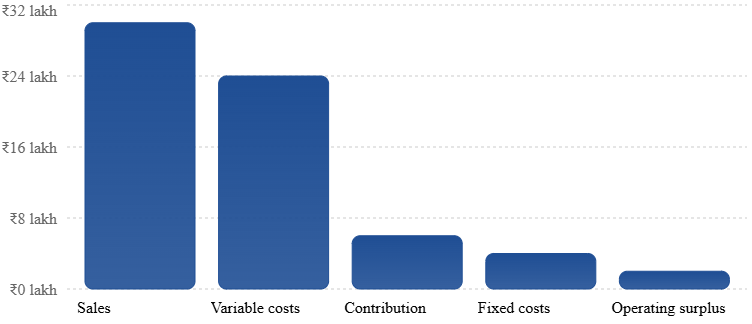
  • Expected monthly sales: ₹30 lakh from wholesale product sales to retailers and commercial customers.
  • Variable costs and contribution margin: ₹24 lakh in product purchase costs, freight and other variable distribution expenses, leaving a contribution of ₹6 lakh, or 20% of sales.
  • Fixed costs: ₹4 lakh per month, including warehouse rent, staff salaries, administration, insurance and other fixed operating expenses.
  • Break-even sales: ₹20 lakh per month, calculated as ₹4 lakh in fixed costs divided by the 20% contribution margin.

Wholesale Distribution Business: Break-Even Analysis

Wholesale Distribution Business — Monthly Financial Snapshot

Illustrative monthly figures in ₹ lakh. Operating surplus is before financing costs, taxes and other excluded expenses.
Risk scenario: Suppose higher supplier prices, freight expenses and competitive pricing reduce the contribution margin from 20% to 15%. Monthly break-even sales then increase to approximately ₹26.67 lakh.

Break-evensales=₹4lakh0.15=₹26.67lakh

Wholesale Distribution Business — Break-Even Analysis

Illustrative monthly sales and total operating costs in ₹ lakh. The baseline assumes a 20% contribution margin; the risk scenario assumes 15%.

■ Sales revenue

■ Total costs — baseline

■ Total costs — risk scenario

At monthly sales of ₹30 lakh, the business would generate ₹4.5 lakh in contribution and retain ₹50,000 after the assumed fixed costs, before financing costs, taxes and other excluded expenses. This compares with ₹2 lakh remaining under the original assumptions.

Planning response: The business plan can recommend reviewing supplier quotations regularly, monitoring gross margins by product category, tracking inventory turnover, negotiating favourable supplier credit terms and setting customer credit limits based on payment history. These controls help management evaluate distribution margins and working capital risks but cannot guarantee a particular financial result.

Frequently Asked Questions

What is a university business plan?

A university business plan explains how a proposed institution will deliver academic programmes, recruit students, manage its campus and fund its operations. It covers institutional objectives, governance, staffing, infrastructure, tuition assumptions, operating costs, financial projections and implementation requirements.

How much investment is needed to start a university in India?

The requirement depends on the institution’s legal structure, campus, programmes and capacity. Major cost heads include land, buildings, laboratories, libraries, technology, faculty, administration, student facilities and pre-opening expenses. Obtain project-specific estimates before setting a funding target.

How do I start a university in India?

Define the institution’s proposed structure, programmes, student capacity and campus requirements. Identify the applicable establishment and recognition rules with qualified advisers and relevant authorities. Prepare the operating plan and financial projections before committing major capital. A business plan does not replace statutory approvals.

What should a university business plan writing service deliver?

A university business plan writing service should produce a structured document covering the institution’s concept, academic programmes, campus requirements, staffing, student recruitment, financial projections and risks. The final scope should match the intended audience and the project information available.

What university business formats can the plan cover?

The plan can address a private university, a specialised institution, a new campus or an expansion project. A university startup business plan focuses on establishment, while a university expansion business plan separates the proposed development from existing operations.

Can a university business plan help attract investors?

Yes. A university business plan for investors can explain the institution’s proposed model, capital requirement, operating assumptions and financial projections. Investors will conduct their own assessment, and any investment remains subject to their criteria and applicable rules.

Conclusion

A university project requires coordinated planning across academic programmes, campus infrastructure, staffing, student recruitment and finance. A well-prepared university business plan helps promoters communicate the institution’s model, examine funding requirements and organise operating decisions. Aviaan can structure the plan around your project’s objectives and intended audience. Contact Aviaan or email advisory@aviaanaccounting.com.

Talk to an Expert

Schedule a complimentary 30-minute discovery call to discuss your requirements.

By submitting, you agree to our Privacy Policy.

Table of Contents

Need Immediate Help?

Our advisory team is ready to assist you.

Let's Build Your Business Success Together

Our senior partners are available to evaluate your current financial structure and identify opportunities for optimization and risk reduction.

Sector Expertise

Our advisory assignments span a wide range of industries, including:

Healthcare
Hospitality
Restaurants & F&B
Retail
Technology & SaaS
Fintech
Real Estate
Manufacturing
Logistics
Education
Automotive
Consumer Products
Professional Services
Renewable Energy
E-commerce
Beauty & Wellness

Each sector requires different demand drivers, economics, competitive factors and valuation considerations. Our analysis is structured accordingly.

Industries We Serve

Tailored financial strategies for specialized sectors.

Real Estate

Healthcare

Manufacturing

Technology

Retail & E comm

Logistics

Services Offered by Aviaan

Feasibility Study

Independent verification of financial statements to ensure transparency and trust.

Business Plan

A comprehensive analysis to evaluate the commercial, technical, and financial viability of a proposed business or project before investment.

Business Valuation

An objective assessment of a company, asset, or investment to determine its fair market value for transactions, reporting, or strategic decisions.

Due Diligence

A detailed financial review to assess risks, validate performance, and ensure informed decision-making in transactions.

Accounting

End-to-end financial recording, reporting, and compliance services to maintain accurate books and support business decision-making.

Market Research

Launching a new venture, expanding into a new geography, raising capital, or entering a new segment, robust market research is critical.

Need Immediate Help?

Our advisory team is ready to assist you with your urgent financial queries.

Services Offered by Aviaan

Feasibility Study

Independent verification of financial statements to ensure transparency and trust.

LEARN MORE →

Business Plan

A comprehensive analysis to evaluate the commercial, technical, and financial viability of a proposed business or project before investment.

LEARN MORE →

Business Valuation

An objective assessment of a company, asset, or investment to determine its fair market value for transactions, reporting, or strategic decisions.

LEARN MORE →

Due Diligence

A detailed financial review to assess risks, validate performance, and ensure informed decision-making in transactions.

LEARN MORE →

Accounting

End-to-end financial recording, reporting, and compliance services to maintain accurate books and support business decision-making.

LEARN MORE →

Market Research

Launching a new venture, expanding into a new geography, raising capital, or entering a new segment, robust market research is critical.

LEARN MORE →

Ready to Speak with an Expert?

Partner with Aviaan Advisory today to unlock your business’s full potential. Our team of experts is here
to provide tailored solutions and guide you every step of the way.

