


AFood packaging businesses must balance material costs, production capacity, food-contact safety and customer requirements before investing in machinery or stock. A small error in material selection, wastage or machine utilisation can put pressure on cash flow.
A food packaging business plan brings the investment, operating model and financial projections into one practical document. It can support a bank loan application, investor discussions, supplier or brand partnerships, government scheme applications, business visa submissions where relevant, and internal planning. Approval always rests with the relevant lender, investor, brand or authority.
Aviaan prepares business plans around the proposed packaging products, customers, equipment, working capital and funding needs. Explore Aviaan and its business plan services to understand how a sector-specific plan can support your next business decision.
Food packaging serves manufacturers, processors, farmers, retailers, restaurants and food brands. Demand for packaging depends on the products being packed, required shelf life, distribution conditions, customer specifications and the cost of materials. Official data can help assess the wider food-processing sector, although it does not provide a single complete measure of the Indian food-packaging market.
Pune is one possible location to assess because it offers access to industrial and food-business customers across Maharashtra. Indore may also suit a supplier serving central Indian processors and distributors. The right city depends on validated demand, freight economics and the cost of operating there, not on city reputation alone.
A food packaging business converts packaging materials into products or services that food businesses can use to pack, protect, label and transport goods. The operation may manufacture packaging, print and convert purchased material, assemble cartons, supply containers wholesale, or provide contract packing.
The right model depends on the buyer’s specifications and the owner’s available capital. A converting unit may buy film or paper rolls and turn them into finished packs. A manufacturing plant may need more equipment, space, quality controls and technical staff. A wholesale supplier may need less production machinery but more stock and working capital.
The plan should define the product range, buyer profile, production route, supplier terms, quality checks, premises, staffing and delivery model. For food packaging, it should also identify whether the material touches food directly, how batches are traced, and how rejected or damaged stock is handled.
An eco-friendly food packaging business plan should specify the material and intended use rather than relying on broad environmental claims. Likewise, a food container manufacturing business plan should reflect the chosen process, equipment, moulds, utilities, maintenance and production yield.
A professional business plan for food processing and packaging can help first-time founders, existing packaging suppliers, manufacturers expanding capacity and entrepreneurs seeking funding or commercial partnerships explain how the business will operate and pay for itself.
Ask Aviaan to prepare a food packaging business plan for your funding or expansion needs.
To write a useful food packaging business plan, define the packaging products and target buyers first, then connect capacity, costs, compliance, funding and cash flow in one consistent model.
Share your product range and proposed capacity with Aviaan to discuss the next steps.
Aviaan develops business plans that connect the packaging operation to its financial requirements. The document is tailored to the proposed products, machinery, customer contracts and funding purpose, rather than relying on a generic manufacturing template.
For broader support, review Aviaan’s business plan services. You can schedule a consultation to discuss the scope, available information and fee before proceeding.
A food packaging business plan should explain the product, production method, customer base, operating costs, compliance needs and funding model in enough detail for informed decisions.
A rice packaging business plan may need to model bag sizes, sealing, printing and seasonal buying patterns. A business plan for honey packaging should address container and closure compatibility, product protection, labelling and batch traceability. A flexible food packaging business plan or corrugated box manufacturing business plan needs its own equipment, material and wastage assumptions. For an eco-friendly food packaging business plan, substantiate material and environmental claims and confirm the requirements that apply to the product.
For a biodegradable packaging business plan, the document should specify the material, intended conditions of use, supplier evidence and any relevant testing or certification. A wholesale food packaging business plan needs to give greater attention to inventory, storage, freight, customer credit and stock turnover.
Request a fixed-fee quote for your food packaging business plan.
Drawn from Aviaan's business planning approach. Client names and details changed to protect confidentiality.
A food packaging business in Ahmedabad wanted to expand its operations to supply packaging materials to food manufacturers, restaurants, cloud kitchens and packaged food brands. The owners needed a business plan to support a funding application and demonstrate how the proposed expansion would manage production costs, customer demand and working capital requirements.
Their existing estimates covered raw materials and basic manufacturing expenses but did not fully account for machinery maintenance, packaging wastage, electricity consumption, labour costs, inventory holding, customer credit periods or delayed payments. The owners needed a financial model showing production costs, expected sales, operating margins, break-even requirements and the additional funding needed for expansion.
Aviaan structured the business plan around food packaging products, identifying the proposed product range, target customer segments, production requirements and distribution channels.
We developed production-costing estimates covering packaging materials, printing, conversion, labour, electricity, machinery maintenance, quality control and packaging wastage.
We prepared a working capital schedule connecting raw material purchases, supplier credit, finished goods inventory, customer credit periods and outstanding invoices.
We assessed the financial implications of different product mixes, including flexible packaging, paper-based packaging, food containers and customized packaging solutions.
We modelled changes in raw material prices, production utilization and customer payment periods to assess how variations in manufacturing costs and sales could affect monthly cash flow.
We prepared projected profit and loss statements, cash flow, balance sheets, break-even calculations and funding requirements to support the proposed financing application.
The completed business plan and financial model provided a structured view of the proposed expansion, expected production economics and funding requirements. The financial analysis highlighted the importance of monitoring raw material consumption, maintaining production efficiency, reviewing customer credit limits and matching inventory purchases with confirmed demand.
The business could use the plan to evaluate machinery investment, estimate working capital requirements and present its financial assumptions consistently during financing discussions. Any lending decision would remain with the bank.
Here is a worked example for an entrepreneur expanding a food packaging manufacturing business in Ahmedabad, supplying packaging materials to commercial customers. The following figures are illustrative assumptions, not a forecast or verified client results.
Food Packaging Business — Monthly Financial Snapshot
Illustrative monthly figures in ₹ lakh. Operating surplus is calculated after variable and fixed costs.
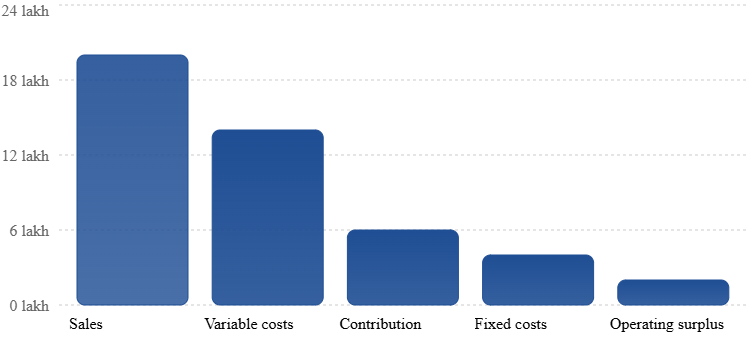
The chart shows how monthly sales translate into contribution and operating surplus. Although the business generates ₹20 lakh in revenue, only ₹2 lakh remains after the assumed variable and fixed costs. This makes production efficiency and cost control important when evaluating the proposed expansion.
The break-even point is where sales revenue equals total operating costs. Below this level, the business incurs an operating loss; above it, the business generates an operating surplus under the stated assumptions.
Break-Even Analysis — Food Packaging Business
Illustrative monthly sales and total operating costs in ₹ lakh. The baseline assumes a 30% contribution margin; the risk scenario assumes 25%.
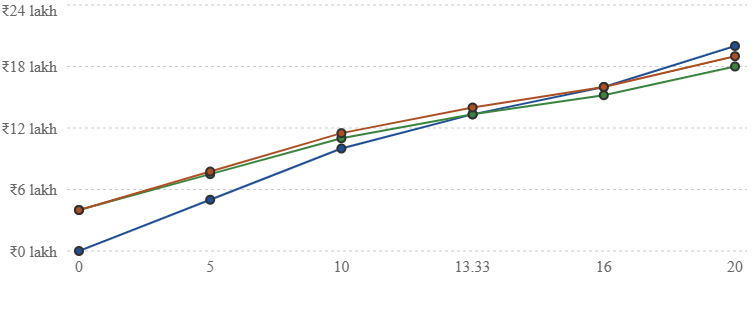
■ Sales revenue
■ Total costs — baseline
■ Total costs — risk scenario
The baseline break-even point is approximately ₹13.33 lakh in monthly sales. If the contribution margin falls from 30% to 25%, the break-even point increases to ₹16 lakh.
Suppose higher raw material prices and increased production wastage reduce the contribution margin from 30% to 25%.
Break-evensales=₹4lakh0.25=₹16lakh
At monthly sales of ₹20 lakh, the business would generate ₹5 lakh in contribution and retain ₹1 lakh after the assumed fixed costs, before financing costs, taxes and other excluded expenses. This compares with ₹2 lakh under the original assumptions.
| Financial indicator | Baseline | Risk scenario |
| Monthly sales | ₹20 lakh | ₹20 lakh |
| Contribution margin | 30% | 25% |
| Contribution | ₹6 lakh | ₹5 lakh |
| Fixed costs | ₹4 lakh | ₹4 lakh |
| Operating surplus | ₹2 lakh | ₹1 lakh |
| Break-even sales | ₹13.33 lakh | ₹16 lakh |
Planning response: The business plan can recommend obtaining updated supplier quotations, monitoring material consumption per production batch, tracking machinery utilization, reviewing product-level margins and negotiating customer payment terms. These controls help management evaluate manufacturing and cash-flow risks but cannot guarantee a particular financial result.
A food packaging business plan is a document describing the products, customers, production process, equipment, staffing, compliance needs and finances of a packaging business. It connects the investment requirement with sales assumptions, operating costs, cash flow, break-even and business risks.
Investment depends on the packaging material, production capacity, machinery, premises and whether you manufacture or trade. Budget for equipment, installation, deposits, raw materials, staff, utilities, testing, registrations, transport and working capital before deciding how much funding to seek.
Choose a packaging category and target buyers, obtain equipment and material quotations, confirm product specifications, assess premises and applicable compliance requirements, then prepare financial projections. Validate customer demand and working capital needs before committing to machinery or taking on significant fixed costs.
A useful business plan for food processing and packaging PDF should cover the business profile, product range, production process, suppliers, customer strategy, project cost, financing, financial projections and risks. Ensure the document reflects your actual operating model and uses traceable assumptions rather than generic figures.
Options include flexible pouches, corrugated cartons, bakery packaging, beverage containers, meat packaging, rice bags, honey containers and wholesale packaging supplies. Each format has different equipment, material, quality and customer needs, so choose one that fits your experience, budget and verified buyer demand.
A lender may consider a food packaging project based on its own eligibility rules, credit assessment, promoter contribution, projected cash flow and supporting documents. A well-prepared plan helps present the case, but it cannot guarantee loan sanction or any particular financing terms.
Requirements depend on the material, product use, manufacturing process and location. Review applicable FSSAI packaging regulations and confirm other relevant factory, environmental, tax and local requirements with the competent authorities or qualified professionals.
Aviaan can discuss a fixed fee after an initial consultation and review of the project scope. The cost depends on the complexity of the packaging operation, available information, financial modelling needs and intended use. Contact the team to request a quote.
A food packaging business needs a clear plan for materials, production capacity, customer requirements, compliance and cash flow. A well-prepared food packaging business plan can help owners evaluate funding needs, test break-even sales and explain the project to lenders, investors or commercial partners. Its value depends on reliable inputs, realistic assumptions and careful review.
Contact Aviaan to discuss your food packaging business plan or email advisory@aviaanaccounting.com




