


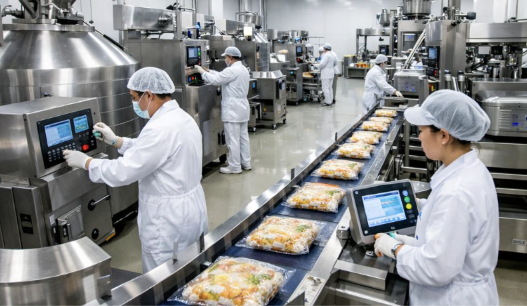
A food processing business plan helps entrepreneurs turn agricultural commodities and food ingredients into safe, marketable products while managing production costs, quality, distribution, and cash flow. Whether you intend to establish a rice mill, dairy processing plant, meat processing facility, snack factory, fruit juice unit, or packaged food brand, your plan should explain how raw materials will be sourced, processed, packaged, sold, and converted into sustainable revenue.
Food processing businesses face challenges beyond buying machinery and producing goods. Seasonal raw material availability, yield losses, food safety, packaging, shelf life, utilities, distribution margins, and payment delays can all affect profitability. A strong plan connects these factors to production capacity and financial forecasts.
This guide explains how to prepare a food production business plan, assess different processing models, estimate startup costs, plan operations, and build financial projections. It also covers specialist considerations for rice milling, dairy, meat, fruit and vegetable processing, nuts, honey, and other packaged food products.

The executive summary should explain the proposed business, product range, target customers, production model, competitive advantage, funding requirement, and expected financial performance. Prepare it after developing the detailed plan so that its claims reflect your actual research and assumptions.
For example, a rice milling business may purchase paddy from farmers or agricultural traders, process it into rice, grade and package the output, and sell to wholesalers, retailers, institutional buyers, or branded consumer markets. A fruit processing business may convert seasonal produce into pulp, juice, sauces, or preserved products.
Your executive summary should answer:
Avoid claiming that demand is guaranteed or that a particular subsidy will be approved. Present the assumptions clearly and distinguish confirmed customer orders from forecast sales.
The right model depends on the raw material available, local demand, investment capacity, production skills, storage requirements, and distribution opportunities.
| Business model | Example products | Main operational priorities | Key financial considerations |
|---|---|---|---|
| Grain processing | Rice, flour, pulses, cereals | Cleaning, grading, milling, dust control, storage | Raw material cost, yield, by-product value, inventory |
| Dairy processing | Milk, curd, paneer, butter, cheese | Chilling, hygienic handling, processing, cold chain | Milk procurement, spoilage, refrigeration, distribution |
| Meat processing | Chilled or frozen meat and approved processed products | Hygienic handling, temperature control, traceability | Facility investment, cold storage, yield, product mix |
| Fruit and vegetable processing | Juice, pulp, sauces, frozen or dried produce | Sorting, washing, processing, packaging, preservation | Seasonality, processing yield, storage, shelf life |
| Snack and potato processing | Chips, snacks, dehydrated products | Preparation, frying or drying, seasoning, packaging | Oil or energy use, packaging, product losses |
| Nuts and dry fruits | Cashews, peanuts, dried fruit, nut spreads | Sorting, grading, roasting, processing, packaging | Raw material quality, yield, product safety |
| Honey processing | Filtering, handling, blending where appropriate, bottling | Quality testing, hygienic filling, traceability | Supplier quality, packaging, batch consistency |
| Chocolate and confectionery | Chocolate, bars, fillings, confectionery | Ingredient control, temperature management, packaging | Ingredient prices, product mix, shelf life |
| Contract processing | Processing and packaging for other brands | Specifications, scheduling, quality assurance | Capacity utilisation, contract pricing, customer concentration |
A small food processing unit business plan should focus on a manageable product range and a realistic sales area. Adding too many products at launch can increase equipment needs, inventory complexity, packaging expenditure, and compliance requirements.
Market research establishes whether enough customers will buy the proposed products at prices that cover production and distribution costs. A food processing business plan should identify the actual market the business can serve, not simply describe the entire food industry as its opportunity.
Potential customer segments include:
Each segment has different expectations. A wholesale buyer may prioritise price, consistent volume, and delivery reliability, while a branded retail customer may place more emphasis on packaging, product differentiation, and repeat purchase.
Assess competing brands, local processors, importers where relevant, wholesalers, and contract manufacturers. Gather information from customer interviews, distributor quotations, retail visits, public tender documents, trade associations, and credible market research.
| Research area | Questions to answer | Business decision supported |
|---|---|---|
| Product demand | Which products sell consistently, and when does demand change? | Product selection and production schedule |
| Competitor pricing | What prices and pack sizes are offered? | Pricing and product positioning |
| Quality expectations | Which specifications, grades, or certifications do buyers require? | Production and testing requirements |
| Distribution | How do products reach wholesalers, retailers, and consumers? | Logistics and channel strategy |
| Seasonality | When are raw materials available, and when do prices fluctuate? | Procurement and storage planning |
| Buyer payment terms | Are customers paying upfront, on delivery, or on credit? | Working-capital forecast |
| Market gaps | Are there unmet needs in pack sizes, processing, quality, or supply? | Differentiation strategy |
Do not treat a competitor's online business plan or promotional claims as independently verified evidence. Validate important assumptions with current supplier quotes and prospective buyers.
Raw material availability and quality directly influence food processing output, yield, cost, and customer satisfaction. The procurement strategy should identify approved suppliers, expected volumes, quality specifications, delivery schedules, and alternative sources.
For agricultural inputs, assess harvest cycles, moisture levels where relevant, transport costs, storage needs, and seasonal price changes. For packaged food ingredients, document supplier specifications, permitted uses, traceability information, and quality requirements.
A practical sourcing plan should include:
Avoid basing profitability solely on the lowest raw material price. Poor-quality inputs can reduce yield, increase waste, interrupt production, or cause finished products to fail quality requirements.
A food processing plant business plan should connect facility design and machinery selection to the product, production volume, hygiene needs, utility availability, and distribution model.
Evaluate the premises against:
The exact layout depends on the product. Dairy and meat facilities may need specific chilled areas and carefully controlled process flows; dry grain processing requires appropriate storage, dust control, and handling systems.
Obtain quotations for each major machine and related installation requirements. The equipment list may include cleaning and sorting systems, mills, mixers, boilers, pasteurisers, dryers, filling machines, packaging equipment, weighing systems, conveyors, refrigeration, laboratory equipment, and material handling tools.
| Equipment category | Typical use | Cost-planning considerations |
|---|---|---|
| Cleaning and grading | Removes or separates unwanted material and grades inputs | Throughput, product type, cleaning efficiency |
| Processing machinery | Milling, mixing, heating, pressing, drying, or other product-specific processes | Capacity, energy use, yield, maintenance |
| Packaging equipment | Filling, sealing, labelling, coding, or wrapping | Pack formats, speed, changeover time |
| Cold storage | Chilled or frozen products where required | Insulation, refrigeration, energy, backup arrangements |
| Quality testing | Product and process checks | Test scope, calibration, consumables, external laboratory fees |
| Utilities | Power, water, compressed air, steam, or other process needs | Installation, consumption, maintenance |
| Material handling | Conveyors, bins, pallets, forklifts, or lifting tools | Handling volume, layout, safety |
| Waste treatment and handling | Manages process waste and wastewater as applicable | Local requirements, volume, treatment method |
Compare equipment on installed cost, output quality, energy consumption, cleaning requirements, service availability, spare parts, warranty, and changeover flexibility—not just purchase price.
A credible food production business plan should map each production stage from receiving raw materials to finished goods dispatch. Capacity estimates must reflect the slowest stage in the production line rather than simply the rated output of the largest machine.
For each product, document the process flow, batch size, cycle time, expected yield, labour requirements, utilities, packaging, and quality checks.
Yield is the proportion of incoming material converted into the relevant saleable output.
Yield (%) = Saleable output weight ÷ Input material weight × 100
For example, if a batch begins with 1,000 kg of raw material and produces 700 kg of saleable finished product, the illustrative yield is 70%. This is a mathematical example, not a benchmark for any particular food product.
By-products may have commercial value, but their revenue should only be included where a realistic buyer, specification, and sale price have been established.
Estimate usable production hours after accounting for cleaning, changeovers, maintenance, staff breaks, and expected downtime. Include storage and dispatch capacity as well as processing throughput.
A plant that can process a large quantity each day may still be constrained by packaging speed, refrigeration, raw material delivery, or customer demand. Use a staged capacity ramp-up rather than assuming full utilisation from the first month.
Different processing sectors require different equipment, controls, sourcing arrangements, and routes to market. The following considerations help tailor a business plan to the selected product.
A rice milling business plan should address paddy procurement, cleaning, dehusking, separation, polishing where applicable, grading, packaging, storage, and by-product handling. The business should estimate the expected saleable rice output from each input batch based on actual trial data or suitable technical estimates.
Rice bran, husk, broken rice, and other outputs may have value depending on quality and local demand. Do not assume that all by-products can be sold at the same price or volume.
Key planning factors include seasonal paddy supply, moisture and quality specifications, mill capacity, power consumption, storage losses, milling recovery, packaging, and the price difference between raw paddy and saleable products.
A dairy processing business plan should explain milk collection, chilling, testing, processing, packaging, cold-chain distribution, and product returns or spoilage. Product selection may include milk, curd, paneer, butter, cheese, or other dairy products depending on the facility and applicable requirements.
Forecast raw milk procurement, processing yield, refrigeration, packaging, route density, delivery frequency, and unsold or returned product. Short shelf-life products require particularly careful demand planning and distribution controls.
A meat processing business plan must account for the applicable approvals, hygienic handling, temperature control, cleaning, traceability, waste management, product testing, and cold-chain requirements. Slaughtering and further processing may have different facility and regulatory implications.
The plan should define the approved product range, sourcing arrangements, processing yield, chilled or frozen storage capacity, transport arrangements, and procedures for handling non-conforming products. Confirm requirements with the relevant food safety, veterinary, environmental, and local authorities before committing to a facility.
A fruit juice production business plan or tomato processing plan should evaluate seasonal produce availability, sorting losses, extraction yield, preservation method, packaging format, storage, and distribution.
Potential products include juice, puree, pulp, sauces, and other processed formats, but each product may require different equipment and validated processing controls. Build forecasts around raw material seasonality and realistic product recovery rather than assuming every kilogram of produce becomes saleable output.
A potato processing business plan may cover chips, frozen products, dehydrated ingredients, or other potato-based products. Important considerations include raw potato quality, storage, preparation losses, oil or energy consumption, seasoning, packaging, product consistency, and distribution.
For a potato chips production business plan, model output per kilogram of raw potatoes, oil use, seasoning, packaging cost, labour, rejected batches, and finished-product shelf life. Validate the yield and cost assumptions through trials or supplier technical data.
A cashew nut processing business plan should consider raw nut sourcing, grading, shelling where applicable, kernel recovery, breakage, quality testing, storage, and packaging. A peanut butter manufacturing business plan should account for ingredient quality, roasting and grinding equipment, texture consistency, packaging, allergen management, and product stability.
A dry fruit processing business plan should address sorting, grading, moisture control where relevant, storage, packaging, and product mix. A honey processing business plan should document sourcing, product identity and quality checks, hygienic handling, filtering where appropriate, bottling, and traceability. A chocolate manufacturing business plan should account for ingredient sourcing, temperature-sensitive processing, product formulation, packaging, and storage conditions.
Each product category requires its own process map, yield assumptions, equipment schedule, and quality plan. Avoid using one generic production model for every food product.
Food safety should be integrated into the facility design and operating plan from the beginning. Poor hygiene, incorrect processing conditions, inadequate traceability, or unsuitable storage can lead to product losses, customer complaints, recalls, and regulatory consequences.
In India, food businesses must assess the applicable registration or licensing requirements under the Food Safety and Standards Act and associated regulations. The relevant route depends on factors such as the nature of the business, product, capacity, and current eligibility criteria.
Consult the official FSSAI registration guidance and FSSAI licensing guidance, and use the FoSCoS portal to review the current application and eligibility process. Do not rely on outdated turnover thresholds or assume that one registration category applies to every manufacturer.
Depending on the product and location, also assess applicable requirements for pollution control, wastewater, factory and worker safety, fire safety, packaging and labelling, weights and measures, tax registration, local trade permissions, and import or export activity. Confirm the current obligations with the appropriate authorities and qualified professionals.
| Control area | Planning requirement |
|---|---|
| Supplier approval | Document supplier checks and input specifications |
| Receiving inspection | Check relevant quality parameters and reject non-conforming inputs |
| Hygiene and sanitation | Establish cleaning procedures, responsibilities, and records |
| Process control | Define product-specific process parameters and monitoring |
| Traceability | Record relevant supplier lots, production batches, and dispatches |
| Testing | Identify appropriate in-house or external laboratory checks |
| Packaging and labelling | Verify materials, declared information, and applicable requirements |
| Storage and transport | Set appropriate conditions and monitoring procedures |
| Complaints and recalls | Document escalation, investigation, corrective action, and recall procedures |
| Staff training | Train personnel on hygiene, process controls, and assigned responsibilities |
Food safety plans should reflect the actual hazard profile and production process. Use qualified food safety professionals and current official guidance when determining required controls, testing, and documentation.
Packaging protects products, communicates essential information, and helps the business reach its intended customers. The correct format depends on the product, shelf life, handling conditions, buyer requirements, and sales channel.
Consider whether the product will be sold in bulk, wholesale packs, retail-ready packaging, food-service formats, or customised packs for another brand. Evaluate material compatibility, sealing, storage, transport durability, packaging costs, and minimum order quantities.
Packaging design should not be finalised until product specifications, shelf-life requirements, mandatory declarations, and relevant regulatory requirements have been reviewed.
Potential channels include:
Each channel has different margins, promotional expectations, payment terms, return policies, and delivery costs. Model the net revenue after discounts, commissions, freight, damage, and returns rather than using the shelf price as the manufacturer's realised revenue.
A food processing unit business plan should identify how the business will win its first customers and build repeat orders. Production capacity is not commercially useful if the company cannot sell its output at viable prices.
B2B sales: Approach wholesalers, retailers, food-service companies, and manufacturers with samples, specifications, quotations, and clear supply terms.
Private-label production: Explore contract manufacturing for established brands where production capabilities, volumes, quality systems, and commercial terms are suitable.
Branded products: Build a clear value proposition around product quality, convenience, provenance, pack sizes, or other substantiated differentiators.
Digital presence: Create product pages, catalogues, technical specifications, enquiry forms, and relevant content that helps buyers evaluate the offering.
Trade and local networks: Participate in appropriate buyer meetings, trade events, distributor outreach, and local business networks.
Do not make unsupported health, nutrition, origin, or quality claims. Marketing statements should match the product's actual attributes and comply with the applicable rules.
Record leads, samples or quotations sent, buyer evaluations, negotiations, first orders, repeat orders, and payments received. Measure conversion at each stage to identify whether the main problem is product fit, pricing, documentation, delivery capability, or follow-up.
Startup costs depend on the product, production scale, location, automation, facility requirements, utilities, and quality controls. A small packaging unit may require a different investment structure from a fully integrated dairy or meat processing facility.
The following table is a budgeting framework rather than a verified cost estimate.
| Cost category | Examples | How to estimate |
|---|---|---|
| Land or premises | Purchase, lease deposit, rent, site preparation | Obtain local property quotations and review permitted use |
| Building and fit-out | Flooring, drainage, partitions, hygienic surfaces | Obtain layout-based contractor estimates |
| Processing machinery | Milling, mixing, heating, extraction, drying, filling | Obtain technical quotations for the required capacity |
| Packaging equipment | Filling, sealing, labelling, coding | Compare pack formats, line speed, and changeover needs |
| Utilities | Electrical systems, water, steam, refrigeration, backup | Estimate installed capacity and ongoing consumption |
| Quality and testing | Instruments, laboratory setup, external testing | Define product-specific test requirements |
| Storage and handling | Racks, bins, pallets, cold rooms, handling equipment | Calculate raw material and finished-goods storage needs |
| Licences and professional services | Applicable approvals, design, legal, accounting, technical advice | Confirm current requirements and quotations |
| Staffing and training | Recruitment, wages, technical training | Prepare a role-by-role staffing schedule |
| Packaging and launch | Packaging inventory, samples, branding, sales materials | Obtain supplier prices and launch estimates |
| Working capital | Raw materials, wages, utilities, packaging, receivables | Prepare a monthly cash-flow forecast |
| Contingency | Delays, rework, installation changes, unexpected costs | Base it on identified project risks |
A complete project budget should distinguish fixed-asset investment, pre-operative expenses, initial inventory, and working capital. Obtain written machinery and installation quotations before presenting the funding requirement to a lender or investor.
Financial projections should connect raw material purchases to production yield, saleable output, pricing, distribution costs, operating expenses, and cash flow. A food processing business plan should include monthly forecasts for the initial operating period and annual projections that reflect expected capacity expansion.
For each product, estimate:
Use the saleable volume expected to be sold, not the plant's maximum rated output, to forecast revenue. If the facility will take time to reach normal production, include a gradual ramp-up.
The following hypothetical example represents a small packaged food processing business. The figures are for demonstrating financial structure only and are not market benchmarks or verified client results.
| Financial item | Illustrative monthly amount |
|---|---|
| Sales revenue | ₹12,00,000 |
| Raw materials and ingredients | ₹6,00,000 |
| Packaging materials | ₹1,00,000 |
| Direct production labour and variable utilities | ₹1,00,000 |
| Total direct costs | ₹8,00,000 |
| Gross profit | ₹4,00,000 |
| Rent and administration | ₹60,000 |
| Sales and distribution | ₹50,000 |
| Quality, maintenance, and other operating costs | ₹40,000 |
| Illustrative operating surplus before depreciation, interest, and tax | ₹2,50,000 |
This simplified example excludes financing costs, depreciation, tax, and other items that may be material. Actual performance will depend on product mix, yield, production utilisation, raw material prices, discounts, quality losses, and collection periods.
Break-even analysis estimates the sales required to cover fixed costs at a given contribution margin.
Break-even revenue = Fixed costs ÷ Contribution margin ratio
For example, if monthly fixed costs are ₹2,00,000 and the contribution margin ratio is 25%, the illustrative break-even revenue is ₹8,00,000 per month.
This calculation assumes the contribution margin ratio remains stable over the relevant sales range. Use actual product-level variable costs and consider whether selling prices or product mix change as output grows.
Food processing businesses can require substantial working capital because raw materials and packaging may need to be purchased before finished goods are sold and customer payments are collected.
The cash-flow model should include raw material stock, packaging inventory, work in progress, finished goods, supplier payment terms, customer credit, seasonal purchasing, spoilage, and debt repayments. Model seasonal peaks separately where the business buys raw materials during a harvest period but sells products throughout the year.
Funding may come from founder capital, bank loans, equipment finance, investors, supplier credit, or eligible public support programmes. The plan should explain the funding amount, intended use, expected timing, repayment capacity, and key risks.
For Indian food processing businesses, the Ministry of Food Processing Industries publishes information about schemes and support programmes through its official website. Its pages include information on food processing and preservation capacity, cluster-related support, and other programme categories. Scheme availability, application windows, eligibility, and assistance conditions can change, so verify the current guidelines before including any potential benefit in a funding plan.
The PMFME scheme information portal also provides scheme details. Do not assume that a business automatically qualifies for a subsidy or that an advertised historical scheme benefit remains available under the same terms. Treat unapproved assistance as a potential funding source, not committed capital.
Use purchase-order approvals, inventory reconciliation, batch-level production records, supplier payment controls, customer credit limits, and monthly management accounts. Compare actual yield, cost per unit, waste, and sales against the plan.
For businesses with seasonal raw materials, prepare a rolling cash-flow forecast and assess whether the company can fund procurement before sales proceeds are collected.
A food processing business plan should identify operational and commercial risks before equipment is purchased and production begins.
| Risk | Potential impact | Mitigation |
|---|---|---|
| Raw material price volatility | Reduced product margins | Supplier diversification, purchase planning, sensitivity analysis |
| Seasonal shortages | Lower production and missed orders | Seasonal procurement plan and suitable storage |
| Poor input quality | Yield loss, rejected batches, quality issues | Supplier qualification and incoming inspection |
| Food safety failure | Product withdrawal, reputational damage, regulatory consequences | Product-specific controls, traceability, training, corrective action |
| Equipment breakdown | Production delays and lost output | Preventive maintenance and critical spare parts |
| Low capacity utilisation | High cost per unit | Secure customer demand and ramp up production realistically |
| Packaging or labelling errors | Rework, rejected goods, or non-compliance | Approved artwork and documented label checks |
| Spoilage and expired stock | Waste and working-capital loss | Forecasting, stock rotation, appropriate storage |
| Delayed customer payments | Cash-flow pressure | Credit controls, receivables follow-up, adequate working capital |
| Customer concentration | Revenue volatility | Diversify customers and distribution channels |
Assign a responsible person to each major risk and document the mitigation action. Food safety, environmental, worker safety, and product-specific regulatory risks require qualified assessment appropriate to the facility.
KPIs help management understand whether production is efficient, quality is consistent, and sales generate sufficient margin and cash.
| KPI | What it measures | Why it matters |
|---|---|---|
| Production yield | Saleable output relative to input | Tracks material efficiency |
| Capacity utilisation | Actual production relative to practical capacity | Reveals underused assets or bottlenecks |
| Cost per unit | Production cost allocated to each saleable unit | Supports pricing and margin decisions |
| Rejection or defect rate | Output failing defined quality requirements | Highlights process and supplier issues |
| Waste and spoilage | Material or product lost during processing and storage | Helps reduce avoidable cost |
| On-time delivery | Orders delivered within agreed timelines | Measures fulfilment reliability |
| Gross margin by product | Revenue less direct product costs | Identifies profitable and weak product lines |
| Inventory days | Time stock remains in inventory | Helps manage cash and spoilage risk |
| Receivables days | Time taken to collect customer payments | Signals working-capital pressure |
| Repeat-order rate | Customers placing additional orders | Indicates satisfaction and commercial fit |
Set targets based on actual product specifications, baseline performance, buyer requirements, and management objectives. Review them monthly and use the results to adjust purchasing, production schedules, pricing, and staffing.
Expansion should follow evidence of repeat demand, reliable quality, sufficient working capital, and stable production performance. Increasing machinery capacity without securing sales or reliable raw material supply can create idle assets and unnecessary financial pressure.
Potential growth strategies include:
Illustrative consulting scenario; not a verified completed client engagement.
A small grain processor wants to expand from bulk sales into branded packaged products. The owner initially assumes that adding packaging equipment will immediately increase profitability.
During planning, management separates bulk and packaged product economics, calculates packaging and distribution costs, estimates retailer margins, and tests customer demand. The revised plan stages the investment and sets sales milestones before committing to the full packaging line.
This approach helps the business compare the value of added processing and branding with the additional costs, operational complexity, and working capital required.
A food processing project requires coordination between market demand, plant capacity, equipment selection, sourcing, quality requirements, and financial planning. A well-prepared plan should reflect the specific product and production process rather than rely on a generic manufacturing template.
Aviaan can support food processing entrepreneurs, agricultural businesses, and manufacturers with business plan development, market assessment, startup-cost modelling, production and sales assumptions, financial projections, working-capital analysis, break-even calculations, and funding-oriented documentation.
The planning scope can be tailored to a rice milling plant, dairy processing facility, packaged food unit, fruit and vegetable processor, snack manufacturer, or other food production model. The objective is to connect the operational plan with realistic financial assumptions and a clear commercial strategy.
Planning a food processing plant or expanding an existing food business? Contact Aviaan to discuss business planning and financial modelling tailored to your product, production model, and growth objectives.
A successful food processing business plan combines validated demand with reliable raw material sourcing, suitable machinery, disciplined production controls, food safety, effective distribution, and realistic financial projections. Whether you are planning a rice mill, dairy plant, packaged food unit, or specialised processing facility, the business plan should show how input materials become saleable products and how those sales generate cash. Validate yield and pricing assumptions, check current regulatory requirements, and plan for seasonal working-capital needs before committing significant capital. Regular performance reviews can help the business improve efficiency and grow sustainably.
A food processing business plan explains the products, target market, sourcing strategy, facility, machinery, production process, food safety controls, sales channels, startup costs, funding needs, and financial projections. It helps assess feasibility and guide investment and operating decisions.
Choose a product with validated demand, assess raw material availability, estimate production capacity, obtain machinery quotations, review applicable approvals, plan food safety controls, and prepare a financial forecast. Include working capital for stock, wages, packaging, utilities, and customer payment delays.
A rice milling business plan should cover paddy sourcing, milling capacity, machinery, expected recovery, by-products, storage, labour, power consumption, packaging, buyers, pricing, working capital, and financial projections. Validate yield and cost assumptions using relevant technical data and local quotations.
Include milk procurement, chilling, testing, processing equipment, packaging, cold-chain logistics, product mix, quality controls, distribution, and spoilage assumptions. Forecast sales and costs by product, and confirm the relevant food safety and facility requirements before investing.
Machinery depends on the product and process. A unit may require cleaning, grading, milling, mixing, heating, drying, filling, sealing, refrigeration, or quality-testing equipment. Obtain technical quotations that specify capacity, installation, utilities, maintenance, and product compatibility.
Requirements depend on the product, facility, capacity, and business activity. Review current FSSAI registration or licensing requirements and assess any additional local, environmental, factory, packaging, tax, and export obligations that apply to the project.
Investment depends on premises, production capacity, machinery, utilities, storage, packaging, quality systems, staffing, and working capital. Prepare a project budget from supplier quotations and include pre-operative expenses, contingency, and cash needed before customer payments arrive.
Estimate saleable output from raw materials, multiply expected sales volume by the realised selling price, and subtract raw material, packaging, production, distribution, and operating costs. Include yield losses, spoilage, by-product revenue only where supported, and financing costs in the wider financial model.
The Ministry of Food Processing Industries publishes information about food processing support programmes. Eligibility, scheme availability, application windows, and benefits vary, so verify current official guidelines and do not include unapproved assistance as committed funding.
Aviaan can support business plan development, market assessment, startup-cost estimates, production and revenue modelling, working-capital forecasts, break-even analysis, and funding-oriented documentation. The plan should be tailored to the product, plant capacity, target market, and available project information.




