


A housing business plan is a structured document explaining how a housing development or housing-related business will operate, obtain funding, attract buyers or tenants and manage financial risks. It connects the project concept to a practical execution strategy.
India’s housing sector includes private residential developments, affordable housing projects, rental properties and community housing initiatives. A sound housing business plan should connect local demand with land costs, project feasibility, funding requirements and the intended sales or rental model.
The final assessment should identify the target housing segment, location, customer profile and delivery model. It should also explain why the proposed project can compete locally. An affordable housing business plan, for example, requires a different pricing and funding approach from a premium residential development.
India’s housing sector includes private residential developments, affordable housing projects, rental properties and community housing initiatives. Demand for housing varies by location, household income, employment opportunities, infrastructure access and affordability. Developers need to assess these local factors before committing capital to a new project.
A housing market analysis should examine household formation, urbanisation, residential construction activity, competing developments, local selling prices and buyer affordability. It should also distinguish between affordable homes, mid-market housing, premium residences, plotted developments and rental housing, as each segment has different customer requirements and financial considerations.
For developers, the opportunity depends on how effectively a proposed project aligns with local demand, land costs, construction expenses and the target customer's purchasing capacity. A well-structured housing business plan connects these market insights with project feasibility, revenue assumptions, funding requirements and financial projections. This helps developers evaluate potential opportunities, identify risks and present a clear development strategy to prospective lenders and investors.
Property developers, affordable housing operators, residential investors, rental housing founders and community housing organisations can use a professionally prepared plan to assess project feasibility and communicate their strategy.
A professional plan also creates a consistent reference for management decisions. It helps the team compare actual progress against planned costs, sales, collections and construction milestones.
Discuss your project with Aviaan: https://aviaanaccounting.com/contact-us/
A business plan for housing development should move from market evidence to operational planning and financial feasibility. Follow these seven steps to build a clear and useful document.
The final document should use consistent assumptions across its market analysis, operating plan and financial projections. Any unsupported figure should be clearly identified for verification rather than presented as established fact.
Aviaan helps businesses structure business plans around commercial feasibility, operational requirements and financial decision-making. For housing ventures, the work can connect the development strategy with its capital needs, revenue model, cost structure and risk controls.
Aviaan can also help align your housing business plan with its wider business plan services and the business plan writing services in India hub.
Share your housing project requirements with Aviaan to discuss the information needed for a suitable plan: https://aviaanaccounting.com/contact-us/
A housing business plan should address the commercial and financial realities of the proposed project. Aviaan can structure the document around the following ten areas, depending on the project scope and information available.
The document can also incorporate a residential real estate business plan, a business plan for rental property, or an affordable housing business plan, depending on the proposed model. Related work may include financial modelling, due diligence and other advisory support where required.
Request a plan tailored to your housing model: https://aviaanaccounting.com/contact-us/
Drawn from Aviaan's business planning approach for the housing and real estate sector. Client names and details changed to protect confidentiality.
A housing business in India wanted to expand its residential development activities by undertaking a new housing project. The owners needed a business plan to assess the project's financial viability, estimate the funding required and demonstrate how construction costs, sales collections and project timelines would affect profitability.
Their initial estimates covered land and construction expenses but did not fully account for approval costs, infrastructure development, contractor payments, marketing expenses, delayed customer collections or the cost of maintaining the project until units were sold. The owners needed a financial model showing project profitability, cash flow requirements, break-even sales and the additional funding needed to complete the development.
Aviaan structured the business plan around the proposed housing project, identifying the target homebuyers, unit mix, pricing strategy and development requirements.
We developed project-costing estimates covering land acquisition, construction materials, labour, contractor charges, utilities, approvals, infrastructure and marketing expenses.
We prepared a project cash flow schedule connecting construction milestones, supplier payments, customer booking advances, instalment collections and outstanding receivables.
We modelled construction cost increases, sales delays and changes in selling prices to assess how these factors could affect project margins and funding requirements.
We prepared projected profit and loss statements, cash flow, balance sheets, break-even calculations and funding schedules to support the proposed project's financial planning.
The completed business plan and financial model provided a structured view of the proposed development, expected project economics and funding requirements. The financial analysis highlighted the importance of monitoring construction costs, aligning project expenditure with customer collections, assessing sales absorption and maintaining sufficient liquidity to manage delays.
The business could use the plan to evaluate its development costs, estimate the funding required at different project stages and present its financial assumptions consistently during financing discussions. Any lending or investment decision would remain with the relevant lender or investor.
Here is a worked example for an entrepreneur developing a residential housing project in Pune, selling housing units to individual homebuyers. These are sample numbers, not a forecast.
Expected monthly sales: ₹50 lakh from housing units sold and recognised as revenue under the project's accounting assumptions.
Variable costs and contribution margin: ₹35 lakh in construction-related and other sales-linked costs, leaving a contribution of ₹15 lakh, or 30% of sales.
Fixed costs: ₹8 lakh per month, including project management, site administration, office expenses, marketing overheads and other ongoing costs.
Break-even sales: Approximately ₹26.67 lakh per month, calculated as ₹8 lakh in fixed costs divided by the 30% contribution margin.
Housing Business: Monthly Financial Comparison
Illustrative monthly figures in ₹ lakh under the base and risk scenarios.
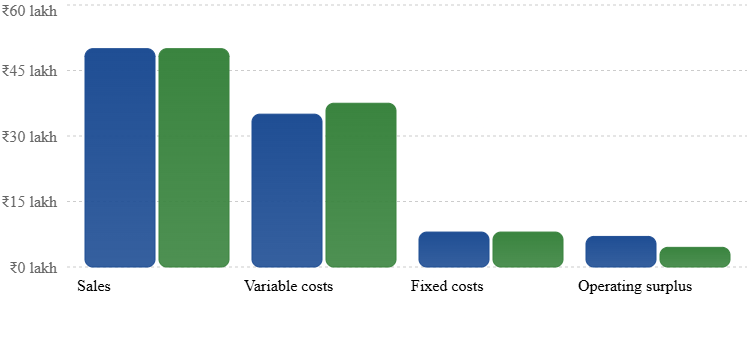
■ Base case
■ Risk scenario
Risk scenario: Suppose higher construction material prices, contractor charges and other project-related expenses reduce the contribution margin from 30% to 25%. Monthly break-even sales then increase to ₹32 lakh:
Break-evensales=₹8lakh0.25=₹32lakh
At monthly sales of ₹50 lakh, the business would generate ₹12.5 lakh in contribution and retain ₹4.5 lakh after the assumed fixed costs, before financing costs, taxes and other excluded expenses. This compares with ₹7 lakh remaining under the original assumptions.
Planning response: The business plan can recommend reviewing construction budgets regularly, tracking actual costs against estimates, aligning contractor payments with project milestones, monitoring booking and collection schedules, and maintaining a cash reserve for sales or construction delays. These controls help management evaluate project cost and cash-flow risks but cannot guarantee a particular financial result.
A housing business plan explains how a housing development or housing-related business will operate, serve its target market and manage its finances. It covers the project concept, demand, costs, revenue model, funding requirements, operational strategy and risks to support informed business decisions.
Include land acquisition, construction, design and professional fees, utilities, approval-related costs, marketing, staffing, financing, insurance and contingency reserves. Rental projects may also need furnishing, maintenance and leasing costs. The final budget should reflect the specific site, project design and applicable requirements.
Define the housing model, assess local demand, identify a suitable site and review ownership, land-title and planning requirements. Prepare project costs, funding assumptions and financial projections before committing capital. Obtain professional legal, technical and regulatory advice where needed.
The supplied list reports business plan for real estate at 5,000 monthly searches, making it the highest-volume related keyword provided. Its stated intent is informational, so use it naturally in an explanatory FAQ or supporting content rather than treating it as equivalent to commercial housing-plan intent.
A real estate development business plan example can help organise market research, project costs, sales assumptions and funding needs. A template is only a starting point. Adapt it to the actual site, housing segment, project structure and local requirements before using it for business or funding discussions.
Yes. It can present project costs, the proposed funding structure, revenue assumptions, cash flow and repayment capacity in an organised format. A bank may also require additional documents, security, approvals and due diligence. A business plan does not guarantee loan approval.
A housing business plan in India should connect local demand, project feasibility, development costs, funding needs and operational planning. Clear assumptions help developers evaluate risks and explain their strategy to potential funders and partners. Aviaan can help structure the analysis and financial model around your proposed housing venture. Contact Aviaan for a consultation or email advisory@aviaanaccounting.com.




