
Wholesale Distribution Business Plan Writing Services in India

Build a profitable wholesale distribution business in India with a professional business plan, market insights, financial projections, and growth strategies.
COMMERCIAL EXCELLENCE

Loading...

Strategic guidance and institutional-grade solutions customized for your enterprise objectives.

Market Research and Feasibility Study for Wholesale Distribution in Africa

Talk to a Financial Expert

Schedule a complimentary 30-minute discovery call to discuss your enterprise’s financial trajectory.
By submitting, you agree to our Privacy Policy.

Table of Contents

A wholesale distribution business can move large volumes of goods while earning relatively modest margins on each sale. Money gets tied up in inventory, customer credit, transport and supplier payments. Poor planning can leave a business short of cash even when orders are coming in.

A wholesale distribution business plan helps owners map the business model, estimate the funding requirement, set stock policies and prepare financial projections. Banks, investors and potential business partners may also request a structured plan before reviewing a proposal. Their final decisions depend on their own checks and requirements.

Aviaan helps entrepreneurs and established traders organise their wholesale business proposals into practical plans. Explore Aviaan and its business plan writing services in India to understand how the service can support your objectives.

Discuss your wholesale distribution business plan with Aviaan.

Wholesale Distribution in India: Stock, Supply and Demand Signals

A wholesale distribution business purchases products from manufacturers, importers or authorised suppliers and resells them to business customers. The distributor earns through the difference between selling prices and the combined costs of buying, storing, handling and delivering goods.

Wholesale distributors connect manufacturers and importers with retailers, institutions, contractors and other business customers. The opportunity depends on product demand, supplier terms, stock turnover, credit control and the cost of reaching customers. National indicators can inform planning, but the business case must reflect the chosen products and trading territory.

  • Market size: A single official figure does not describe the entire wholesale distribution market across every product category. Use the Ministry of Micro, Small and Medium Enterprises' Udyam registration data to explore registered enterprises by district, while recognising that registrations are not a measure of wholesale demand.
  • Market growth: Assess growth for the actual product category and customer base. The Office of the Economic Adviser publishes wholesale price indices that help businesses monitor commodity price movements, not distributor sales growth.
  • Market forecasts: Build the sales forecast from the number of target accounts, likely order sizes, repeat frequency and product availability. Do not treat national price movements as proof of future sales.
  • Product segmentation: Separate the proposed range into categories such as fast-moving consumer goods, industrial supplies, electrical goods, building materials, food products or medical supplies. Each category has different storage, handling, shelf-life and credit needs.
  • Geographic segmentation: Define the service territory by delivery distance, road access, customer concentration, warehouse location and freight cost. A wide territory may increase potential reach but can also raise delivery expenses.
  • Consumer demographics: For wholesale businesses, assess business customers rather than relying only on household demographics. Identify retailers, manufacturers, contractors, hospitality operators or institutions by their purchasing patterns and account requirements.
  • Consumer spending: Estimate the buying capacity of target accounts using order history, customer interviews, credit limits and observed purchasing patterns. Wholesale demand is often driven by business needs and inventory cycles rather than individual consumer spending alone.
  • Competitor benchmarking: Compare local distributors on product availability, delivery reliability, credit terms, minimum order quantities, returns handling and supplier access. Build the business's position around specific service advantages.
  • Industry trends: Track product substitution, digital ordering, inventory visibility, shorter delivery expectations and changes in supplier terms. Confirm which developments matter to the selected product category before including them in the plan.
  • Consumer preferences: Understand what business buyers value: dependable stock, competitive landed prices, suitable pack sizes, accurate invoices, predictable delivery and responsive after-sales support.
  • Demand drivers: Link demand to customer industries, construction activity, manufacturing requirements, retail replenishment or other relevant end uses. The business plan should explain why target customers will buy the selected range.
  • Government policies: Check applicable GST, import-export, product standards, labelling, storage and sector-specific rules. The requirements differ by product, state and trading model, so confirm them with the relevant authorities or a qualified professional.
  • Distribution channels: Plan direct account sales, field representatives, online ordering, institutional contracts, dealer networks or authorised distributorships according to the product and customer type.
  • Regional opportunities: Assess industrial estates, retail trading centres, transport links and customer clusters. A location with lower rent may not be cheaper overall if it increases freight, delivery time or stock replenishment costs.
  • Industry challenges: Plan for slow-moving stock, customer defaults, price changes, supplier concentration, product damage, returns and delayed collections. Each risk can reduce cash available for purchasing new inventory.
  • International benchmarking: Where imported goods or overseas suppliers matter, compare supplier lead times, freight, duties, currency exposure and payment conditions. Overseas examples should be adapted to Indian operating costs and customer expectations.
  • Business feasibility indicators: Track gross margin, stock turnover, receivable days, payable days, delivery cost, inventory losses and working capital. These measures help show whether sales volume can support the cash needed to trade.

India's commercial centres and industrial regions may offer different opportunities depending on the goods being distributed. Ahmedabad can suit selected industrial and trading categories, while Jaipur may be relevant for building supplies, consumer goods and regional trade. These are starting points for location research, not claims of guaranteed demand. A tailored wholesale business plan India should test the proposed territory against real customer and supplier information.

Why You Need a Professional Wholesale Distributor Business Plan

A professional wholesale distributor business plan helps first-time founders, existing traders expanding their product range, authorised distributor applicants and investors evaluate how the business will operate and fund its stock cycle.

  • Funding clarity: A bank or investor can review the intended use of funds, working capital requirement, repayment assumptions and key business risks.
  • Supplier and brand discussions: A structured proposal can explain the territory, customer base, storage capacity, sales team and distribution capability to a prospective supplier or brand. Appointment remains at the brand's discretion.
  • Stock and cash planning: Product-level assumptions help determine opening inventory, reorder quantities, safety stock and the cash required to fulfil customer orders.
  • Margin protection: The plan accounts for freight, storage, discounts, returns, breakage, credit losses and other costs that can erode the gross margin.
  • Credit and supply risks: A written approach to customer credit, supplier concentration and slow-moving inventory helps owners prepare for interruptions and collection delays.

The plan can also support internal budgeting, franchise or distributorship discussions, and applications for relevant government schemes. Eligibility and approval depend on the relevant institution or authority.

Ask Aviaan to help structure your wholesale business plan.

How to Write a Wholesale Distribution Business Plan in India

To prepare a wholesale distribution business plan, define the product range and territory, validate the customer base, agree supplier assumptions, calculate working capital and build financial projections that reflect the stock-to-cash cycle.

  1. Define the business model: Decide whether the company will buy and resell goods, act as an authorised distributor, serve institutions or manage a regional supply network.
  2. Select products and customers: Specify the product categories, target buyer types, order sizes, repeat frequency and service area the business can realistically cover.
  3. Confirm supplier conditions: Record purchase prices, minimum orders, credit terms, lead times, delivery responsibilities, return policies and any territory or brand conditions.
  4. Plan warehouse and logistics: Estimate storage space, handling equipment, inventory systems, staffing, delivery arrangements and the cost of serving the intended territory.
  5. Build a sales and credit plan: Set account acquisition targets, pricing rules, customer credit limits, collection procedures and policies for overdue invoices.
  6. Prepare the financial model: Calculate startup costs, stock funding, gross margin, operating expenses, cash flow, break-even sales and sensitivity to delayed collections or higher freight costs.
  7. Write the executive summary last: Summarise the business proposition, product range, customers, funding need, operations and financial outlook after the detailed plan is complete.

Supporting documents may include supplier quotations, proposed distributorship terms, warehouse estimates, customer enquiries and owner credentials. Where figures remain unconfirmed, label them as assumptions and update them before presenting the plan to a lender, investor or brand.

Share your product category and expansion plans with Aviaan.

How Aviaan Can Help You Prepare a Wholesale Distribution Business Plan

Aviaan prepares business plans that connect a distributor's sales model with its purchasing needs, operating costs and funding requirements. The work is tailored to the goods being traded, the customers being served and the purpose of the document.

  • Approval-focused writing: The plan presents the business model, promoter background, proposed funding and use of funds in a format suited to discussions with banks, investors or prospective distribution partners.
  • Distribution-specific financials: The financial model covers inventory investment, supplier payments, customer credit, delivery costs, margins and cash flow.
  • Finance-led preparation: Financial planning and business analysis are brought together so that projected sales, expenses and working capital remain consistent.
  • Support across India: Aviaan serves businesses across India, with an office in Belapur, Navi Mumbai, for coordinating planning requirements and client discussions.

Our Simple 5-Step Process

  1. Initial discussion: Explain the product category, proposed territory, current business position and intended use of the plan.
  2. Collecting business numbers: Share available purchase prices, supplier terms, customer details, warehouse costs, staffing estimates and funding requirements.
  3. Plan and financial model: Aviaan organises the business narrative and develops projections based on the agreed inputs and assumptions.
  4. Review and refinement: Review the draft, clarify cost assumptions and adjust the plan to reflect confirmed information.
  5. Final business plan: Receive the completed document and supporting financial schedules for the agreed purpose.

What Aviaan's Wholesale Distribution Business Plan Includes

A wholesale distribution business plan from Aviaan can cover the following ten sections, adapted to the company's products, supply chain and funding objectives.

  1. Executive summary: The business proposition, target customers, distribution territory, funding requirement and main financial assumptions.
  2. Business profile: Ownership, experience, product categories, operating model, proposed structure and business objectives.
  3. Local demand and customer assessment: The target account base, buying patterns, territory coverage, competitor activity and demand assumptions.
  4. Product mix and pricing: Product categories, purchase costs, selling prices, discount policy, expected margins and inventory priorities.
  5. Supplier and distribution arrangements: Supplier terms, minimum orders, territory conditions, payment schedules, delivery responsibilities and proposed brand relationships.
  6. Operations and logistics plan: Warehouse needs, stock handling, order processing, transport, inventory controls, returns and staff responsibilities.
  7. Sales, credit and collection plan: Customer acquisition, account management, credit limits, invoice follow-up, overdue account handling and sales targets.
  8. Compliance roadmap: Applicable GST requirements, business registrations, import-export requirements where relevant, product standards and sector-specific permissions. Requirements should be confirmed with the appropriate authorities or qualified professionals.
  9. Financial projections: Project costs, means of finance, revenue, gross margin, operating expenses, cash flow, profit and loss, balance sheet, break-even sales and debt repayment assumptions where relevant.
  10. Risk and implementation plan: Slow-moving stock, supplier disruption, delayed collections, price changes, inventory losses, contingency actions and launch milestones.

[IMAGE: Infographic showing the ten sections of a wholesale distributor business plan, from executive summary to risk and implementation.]

The document can be tailored to a distribution startup business plan, an established wholesale trader expanding into new territories or a business applying for a distributorship. It can also support a wholesale startup business plan where the founder needs to assess inventory funding and the costs of reaching the first customer accounts.

Request a fixed quote from Aviaan.

Case Study: Business Plan for a Pharmaceutical Business in India

Drawn from Aviaan's business planning approach for the pharmaceutical industry. Client names and details changed to protect confidentiality.

Problem

A pharmaceutical business in India wanted to expand its operations by supplying medicines and healthcare products to pharmacies, hospitals and other healthcare providers. The owners needed a business plan to support a working capital loan application and demonstrate how the business would manage inventory, supplier payments and customer collections while expanding its distribution network.

Their existing estimates covered medicine purchases and staff costs but did not fully account for inventory expiry, storage requirements, transportation expenses, customer credit periods or delayed payments from institutional buyers. The owners needed a financial model showing expected sales, gross margins, working capital requirements and the additional funding needed to support expansion.

Solution

Aviaan structured the business plan around pharmaceutical distribution, identifying the proposed product categories, customer segments, supplier arrangements and operating requirements.

We developed cost estimates covering medicine procurement, packaging, warehousing, transportation, staff salaries, storage equipment and other operating expenses.

We prepared a working capital schedule connecting supplier credit terms, inventory holding periods, customer credit periods, outstanding invoices and recurring stock purchases.

We modelled changes in procurement costs, inventory expiry, sales volumes and customer payment delays to assess how these factors could affect margins and monthly cash flow.

We prepared projected profit and loss statements, cash flow, balance sheets, break-even calculations and funding schedules to support the proposed financing application.

Result

The completed business plan and financial model provided a structured view of the proposed expansion, expected sales economics and funding requirements. The financial analysis highlighted the importance of monitoring product-level margins, managing inventory expiry, negotiating supplier credit terms and maintaining sufficient working capital for delayed customer collections.

The business could use the plan to evaluate its expansion costs, estimate the funding required to maintain inventory and present its financial assumptions consistently during financing discussions. Any lending decision would remain with the bank.

Real-World Example: Planning a Pharmaceutical Business in Hyderabad

Here is a worked example for an entrepreneur expanding a pharmaceutical distribution business in Hyderabad, supplying medicines and healthcare products to pharmacies, clinics and hospitals. These are sample numbers, not a forecast.

Expected monthly sales: ₹20 lakh from pharmaceutical products supplied to pharmacies, clinics and institutional customers.

Variable costs and contribution margin: ₹13 lakh in medicine procurement, packaging, transportation and other sales-linked costs, leaving a contribution of ₹7 lakh, or 35% of sales.

Fixed costs: ₹4 lakh per month, including staff salaries, warehouse rent, utilities, storage expenses and administration.

Break-even sales: Approximately ₹11.43 lakh per month, calculated as ₹4 lakh in fixed costs divided by the 35% contribution margin.
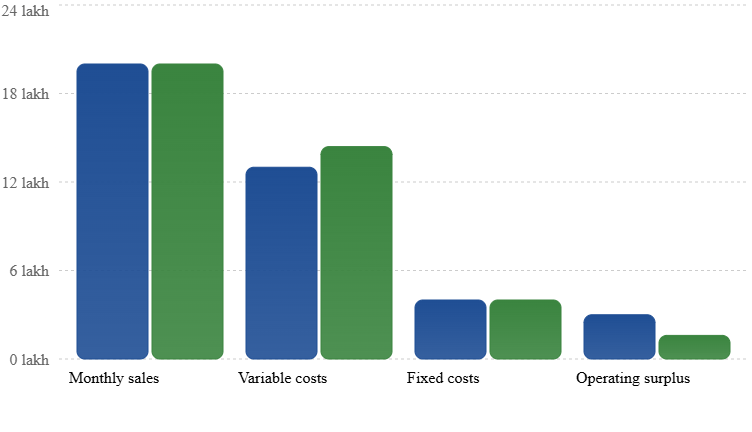
Pharmaceutical Business: Break-Even Analysis

■ Base case

■ Risk scenario

Risk scenario: Suppose higher medicine procurement costs, additional distribution expenses and pricing pressure reduce the contribution margin from 35% to 28%. Monthly break-even sales then increase to approximately ₹14.29 lakh:

Break-evensales=₹4lakh0.28=₹14.29lakh

At monthly sales of ₹20 lakh, the business would generate ₹5.6 lakh in contribution and retain ₹1.6 lakh after the assumed fixed costs, before financing costs, taxes and other excluded expenses. This compares with ₹3 lakh remaining under the original assumptions.

Planning response: The business plan can recommend reviewing supplier quotations, tracking margins by product category, monitoring expiry dates, aligning inventory purchases with demand, negotiating supplier credit periods and following up on overdue customer payments. These controls help management evaluate inventory, cost and cash-flow risks but cannot guarantee a particular financial result.

Frequently Asked Questions

What is a wholesale distribution business plan?

A wholesale distribution business plan describes how a company will source products, store inventory, sell to business customers and manage deliveries, credit and cash flow. It includes the operating model, funding requirements, financial projections, key risks and actions needed to run the business.

How much investment is needed to start a wholesale distribution business in India?

Investment depends on the product range, warehouse, stock levels and customer credit terms. Budget for opening inventory, premises deposit, shelving, handling equipment, transport, staff, technology, registrations, insurance and working capital to cover the gap between supplier payments and customer collections.

How do I start a wholesale distribution business in India?

Choose a product category, identify business customers, compare suppliers and confirm purchase terms. Estimate inventory and working capital, select suitable premises, set prices and credit policies, check applicable registrations, and prepare a business plan before committing to substantial stock purchases.

What should a wholesale distributor business plan India include?

A wholesale distributor business plan India should cover products, suppliers, customer segments, territory, logistics, inventory controls, pricing, sales targets and financial projections. It should also explain how the business will manage delayed collections, slow-moving stock and supplier payment commitments.

What wholesale distribution business ideas and formats can I consider

Options include FMCG distribution, industrial supplies, electrical goods, building materials, packaged food, agricultural inputs and institutional supply. A wholesale company business plan should match the chosen category with supplier access, customer demand, storage needs, applicable compliance and the available working capital.

Conclusion

A carefully prepared wholesale distribution business plan helps business owners understand their stock funding, margins, customer credit and operating costs before expanding or launching. Aviaan can help structure the business case and financial projections for internal planning, funding discussions or distribution proposals. The plan supports better decisions, while banks, brands and authorities retain control over their approval processes.

Contact Aviaan to discuss your wholesale distribution business plan, or email advisory@aviaanaccounting.com to request a consultation.

Talk to an Expert

Schedule a complimentary 30-minute discovery call to discuss your requirements.

By submitting, you agree to our Privacy Policy.

Table of Contents

Need Immediate Help?

Our advisory team is ready to assist you.

Let's Build Your Business Success Together

Our senior partners are available to evaluate your current financial structure and identify opportunities for optimization and risk reduction.

Sector Expertise

Our advisory assignments span a wide range of industries, including:

Healthcare
Hospitality
Restaurants & F&B
Retail
Technology & SaaS
Fintech
Real Estate
Manufacturing
Logistics
Education
Automotive
Consumer Products
Professional Services
Renewable Energy
E-commerce
Beauty & Wellness

Each sector requires different demand drivers, economics, competitive factors and valuation considerations. Our analysis is structured accordingly.

Industries We Serve

Tailored financial strategies for specialized sectors.

Real Estate

Healthcare

Manufacturing

Technology

Retail & E comm

Logistics

Services Offered by Aviaan

Feasibility Study

Independent verification of financial statements to ensure transparency and trust.

Business Plan

A comprehensive analysis to evaluate the commercial, technical, and financial viability of a proposed business or project before investment.

Business Valuation

An objective assessment of a company, asset, or investment to determine its fair market value for transactions, reporting, or strategic decisions.

Due Diligence

A detailed financial review to assess risks, validate performance, and ensure informed decision-making in transactions.

Accounting

End-to-end financial recording, reporting, and compliance services to maintain accurate books and support business decision-making.

Market Research

Launching a new venture, expanding into a new geography, raising capital, or entering a new segment, robust market research is critical.

Need Immediate Help?

Our advisory team is ready to assist you with your urgent financial queries.

Services Offered by Aviaan

Feasibility Study

Independent verification of financial statements to ensure transparency and trust.

LEARN MORE →

Business Plan

A comprehensive analysis to evaluate the commercial, technical, and financial viability of a proposed business or project before investment.

LEARN MORE →

Business Valuation

An objective assessment of a company, asset, or investment to determine its fair market value for transactions, reporting, or strategic decisions.

LEARN MORE →

Due Diligence

A detailed financial review to assess risks, validate performance, and ensure informed decision-making in transactions.

LEARN MORE →

Accounting

End-to-end financial recording, reporting, and compliance services to maintain accurate books and support business decision-making.

LEARN MORE →

Market Research

Launching a new venture, expanding into a new geography, raising capital, or entering a new segment, robust market research is critical.

LEARN MORE →

Ready to Speak with an Expert?

Partner with Aviaan Advisory today to unlock your business’s full potential. Our team of experts is here
to provide tailored solutions and guide you every step of the way.

