


Launching a commercial candy factory, artisanal chocolate boutique, or traditional sweets manufacturing chain requires balancing perishable ingredient costs, cold chain logistics, and seasonal demand peaks. Upfront capital is allocated to commercial planetary mixers, chocolate tempering tanks, automated wrapping machinery, cold storage display units, and climate-controlled vehicles. Without strict financial controls and recipe yield monitoring, raw material price fluctuations and high seasonal unsold inventory can quickly strain operating liquidity.
A custom confectionery business plan protects your capital investment by mapping batch yield economics, shelf-life packaging costs, cold-chain distribution expenses, and working capital needs. Commercial banks require verified debt service projections before approving term loans under government schemes like CGTMSE or MSME credit lines, while retail landlords and food safety inspectors evaluate kitchen layouts and hygiene protocols before issuing permissions. Establishing a structured operational roadmap ensures your food production unit maintains healthy cash flow across festive demand surges and quiet summer months.
Aviaan provides specialized project reports, financial projections, and strategic plans for food entrepreneurs, bakery operators, and sweet shop owners. Our advisors build investor-grade documentation aligned with Indian banking standards and Ministry of Food Processing Industries guidelines. Whether you are setting up a local retail sweet shop or scaling an industrial candy plant, our business plan writing services in India align your production capacity with institutional funding expectations.
Connect with our specialists at Aviaan to structure your facility expansion roadmap
Demand for packaged chocolates, baked goods, traditional Indian sweets, and sugar confectionery is expanding rapidly across domestic retail channels and regional distribution networks. Establishing a confectionery production unit requires analyzing raw ingredient supply, cold chain access, state food safety standards, and regional consumer preferences.
Market size: Gross Value Added (GVA) in Indian food processing sector reached ₹2.24 lakh crore, highlighting the large scale of domestic food processing activity (PIB MoFPI Release).
Market growth: The food processing sector achieved an average annual growth rate of 6.55 percent, outperforming general manufacturing growth averages (PIB MoFPI Release).
Market forecasts: Central government programs like the Production Linked Incentive Scheme for Food Processing Industries (PLISFPI) incentivize domestic food manufacturing capacity expansion with an outlay of ₹10,900 crore (PIB PLISFPI Factsheet).
Product segmentation: Product categories comprise hard-boiled candies, molded chocolates, bakery items, traditional milk-based sweets, gummies, and premium artisanal gift boxes.
Geographic segmentation: Production and retail consumption hubs concentrate in major urban belts across Maharashtra, Gujarat, Uttar Pradesh, Tamil Nadu, West Bengal, and Rajasthan.
Consumer demographics: Primary buyers include urban household consumers, festive gift shoppers, school and college youth, corporate gifting clients, and quick-commerce platform shoppers.
Consumer spending: Individual consumer spending on premium packaged chocolates, clean-label sweets, and impulse confectionery items continues to grow across urban centers.
Competitor benchmarking: Market dynamics balance multinational chocolate brands with regional sweet shop chains and boutique artisanal chocolatiers competing on freshness, recipe uniqueness, and shelf presentation.
Industry trends: Industry shifts focus on sugar-free alternatives, dark chocolate formulations, bio-degradable packaging materials, and direct-to-consumer e-commerce fulfillment.
Consumer preferences: Buyers prioritize FSSAI-certified food safety standards, transparent ingredient labeling, tamper-evident packaging, consistent flavor profiles, and extended shelf life.
Demand drivers: Growth stems from expanding middle-class disposable income, year-round festive celebrations, rapid growth of quick-commerce delivery apps, and gifting culture.
Government policies: Food processing units operate under mandatory Food Safety and Standards Authority of India (FSSAI) licensing, Legal Metrology packaging rules, and municipal health trade norms (FSSAI Portal).
Distribution channels: Sales move through retail store counters, modern trade supermarket chains, traditional wholesale stockist networks, quick-commerce apps, and corporate sales teams.
Regional opportunities: Tier-2 commercial hubs offer significant growth potential due to lower real estate lease costs and strong local demand for hygienic packaged sweets.
Industry challenges: Key pressures include rising prices for cocoa, sugar, and dairy solids, managing cold-chain integrity during hot summer months, and short product shelf-life risks.
International benchmarking: Leading facilities adopt ISO 22000 Food Safety Management Systems, HACCP quality controls, automated batch mixing machines, and modified atmosphere packaging (MAP).
Business feasibility indicators: High gross profit margins on specialty confectionery items support solid operating returns when batch wastage stays below three percent.
Demand for packaged chocolates, baked goods, and traditional sweets remains strong across major metropolitan markets and tier-2 commercial centers. States like Rajasthan, Tamil Nadu, Maharashtra, and Uttar Pradesh offer distinct strategic advantages due to established agricultural supply chains and skilled food processing labor. Utilizing a structured business plan for confectionery operations enables food founders to capitalize on these sector opportunities effectively.
Launching or expanding a confectionery facility requires substantial capital for specialized food processing machinery, commercial kitchen ventilation, refrigerated display cases, and raw ingredient inventories. Whether you are a pastry chef opening a boutique shop, an existing sweet maker scaling into automated packaging, or a food entrepreneur launching a candy brand, a structured business plan for confectionery protects your capital. Commercial lenders, equity partners, and food safety inspectors evaluate your kitchen layout, batch cost economics, and cash flow stability before approving loans or issuing operational permits.
Securing Bank Debt and MSME Credit: Financial institutions examine debt service coverage ratios, equipment quotes, and promoter equity before granting machinery term loans or working capital limits.
Structuring Multi-Unit Retail Chains: Expansion partners analyze store-level unit economics, wastage ratios, and supply chain logistics using a confectionery shop business plan layout.
Managing Raw Material Price Volatility: Strategic ingredient budgeting prevents cocoa or dairy price hikes from eroding profit margins using a business plan on bakery and confectionery approach.
Protecting Margins on Bulk Wholesale Deals: Detailed batch costing prevents unexpected packaging or transport costs from consuming margins across distributor contracts using a startup business plan framework.
Managing Festive Cash Flow Swings: Strategic financial modeling ensures the facility maintains adequate liquidity during quiet non-festive months.
Structuring a comprehensive operational plan ensures your production unit maintains high food safety standards while meeting financial commitments.
Schedule an initial consultation with our advisory team to discuss your facility plans
A successful confectionery shop business plan details your recipe menu, processing equipment, kitchen layout, and multi-year financial forecasts clearly. Follow these seven steps to structure an investor-ready document:
Define Your Product Menu and Target Audience: Detail whether your facility produces molded chocolates, hard candies, traditional milk sweets, fresh bakery goods, or corporate gift hampers.
Detail Equipment and Facility Setup Costs: Calculate expenses for planetary mixers, tempering machines, cooling tunnels, wrapping machinery, cold display counters, and commercial HVAC using a Small business plan framework.
Establish Production Workflows and Staffing: Map requirements for head confectioners, pastry chefs, kitchen operators, packaging staff, quality checkers, and retail sales representatives.
Build a Financial and Recipe Cost Model: Outline raw ingredient costs per batch, packaging expense per unit, retail margins, distributor commission splits, and fixed lease overheads using an ecommerce business plan layout.
Establish Food Safety and Regulatory Compliance: Document FSSAI state or central manufacturing licenses, Legal Metrology packaging declarations, Fire NOC, and GST registration.
Design Marketing and Retail Acquisition Strategies: Define digital lead campaigns, festive gifting catalogs, corporate outreach, quick-commerce onboarding, and local billboard advertising.
Write the Executive Summary Last: Summarize promoter credentials, facility capacity, capital requirements, break-even timelines, and projected profit margins after finalizing all technical sections.
Executing these steps ensures your document satisfies both commercial bank underwriting standards and retail landlord evaluation criteria.
Contact our advisors to begin drafting your project report
Aviaan assists food entrepreneurs, bakery operators, and confectionery manufacturers in preparing bankable project reports and financial models. Developing a market research business plan requires balancing recipe economics with institutional credit underwriting standards. Our team presents your production capacity, ingredient yield calculations, and retail market potential effectively to commercial banks, government scheme sanctioning committees, and private investors. Entrepreneurs seeking specialized market research services for business plan development benefit from our data-driven approach.
Credit-Aligned Project Documentation: We prepare financial plans that meet the exact underwriting criteria of nationalized banks, private lenders, and MSME credit channels.
Sector-Specific Financial Modeling: Our models account for recipe batch yields, ingredient price inflation, packaging losses, cold-chain transport costs, and seasonal sales swings.
Finance-Led Advisory Team: Experienced financial analysts and credit advisors structure your financial projections to maintain clear liquidity visibility.
Nationwide Client Support: We support food manufacturing and retail projects across all major Indian commercial centers from our dedicated office in Belapur, Navi Mumbai.
Initial Business Discovery: We review your proposed menu, target retail channels, machinery quotes, recipe costs, and capital needs.
Data Gathering and Cost Structuring: Our team compiles verified cost benchmarks for commercial food machinery, ingredient bulk rates, lease expenses, and compliance overheads.
Financial Modeling and Plan Drafting: We construct multi-year financial statements, cash flow forecasts, break-even analyses, and narrative plan sections.
Interactive Review Session: We walk you through every financial assumption, batch yield parameter, and unit margin calculation to ensure complete accuracy.
Final Document Delivery: You receive an institutional-ready project report formatted for bank debt appraisal, FSSAI loan applications, or investor presentations.
To discover how our team supports your food business setup, explore our comprehensive range of business plan services or visit our business plan writing services in India guide.
Reach out to our advisors to discuss your project scope
Our advisors deliver a complete, institutional-ready project report that covers every operational, legal, and financial aspect of your confectionery venture using a market research and business plan foundation.
Executive Summary: Concise overview of company vision, product menu, promoter background, capital requirements, and projected financial returns.
Business Profile: Detailed corporate structure, plant location in a commercial food zone, machinery layout, and long-term expansion goals.
Local Market & Food Industry Analysis: Assessment of regional confectionery demand, festive gifting cycles, competitor pricing, and market growth opportunities.
Product Line & Batch Costing Architecture: Detailed costing for chocolates, candies, baked goods, traditional sweets, and specialized food business plan, boutique business plan, Sweets Shop Business Plan, or manufacturing business plan offerings, alongside an integrated Retail Business Plan module.
Machinery & Processing Specs: Specifications for tempering tanks, planetary mixers, flow-wrapping machines, cold storage rooms, and climate control units.
Operations & Kitchen Workflows: Raw material receiving protocols, batch cooking procedures, molding workflows, quality inspection, and packaging standards.
Compliance & Food Safety Roadmap: Regulatory register covering FSSAI Manufacturing License, Legal Metrology registration, GST compliance, and Municipal Health Trade License.
Organization & Staffing Plan: Organizational chart covering master chefs, machine operators, packaging assistants, quality managers, and sales staff with salary schedules.
Financial Projections: Complete financial package including startup costs, debt-equity mix, monthly P&L statements, cash flow forecasts, balance sheets, and debt coverage ratios.
Risk Management & Scenario Sensitivity: Sensitivity analysis testing financial performance against ingredient price hikes, higher power costs, cold chain breakdowns, and seasonal demand drops.
Founders seeking pre-formatted presentation layouts or reference documents often review downloadable resources like a bakery and confectionery business plan pdf, Confectionery Business Plan PDF, or a business plan template for confectionery shop during early feasibility studies. For founders expanding into adjacent consumer retail or hardware verticals, our specialists also design tailored plans such as an electronics store business plan in India or a battery shop business plan in India.
Request a fixed quote for your custom project report
Drawn from Aviaan’s business planning approach for the confectionery and food manufacturing sector. Client names and details have been changed to protect confidentiality.
An established traditional sweet manufacturer in Madurai, Tamil Nadu, planned to establish an automated, hygienic production facility for packaged chocolates and extended-shelf-life traditional sweets for distribution across South India. The promoters required a term loan of ₹1.30 crore to purchase automated wrapping machines, continuous cooking kettles, and cold-storage vehicles.
However, public sector bank credit officers deferred the loan application because the initial proposal lacked detailed recipe-yield calculations, shelf-life testing documentation, and a clearly defined cold-chain risk management plan. These gaps made it difficult for the bank to assess production efficiency, product safety, distribution risks, and debt repayment capacity.
Aviaan supported the promoters by preparing a detailed, bank-oriented project report and financial plan.
According to the case details, the promoters resubmitted their loan application with the revised project report. The updated financial projections provided the credit committee with clearer information about production yields, seasonal cash flows, and projected debt-servicing capacity.
The term loan was reportedly approved, allowing the company to acquire the machinery and launch its expanded product line on schedule.
The following financial model demonstrates the operating economics of a mid-sized packaged sweets and chocolate production facility in an industrial estate in Jaipur, Rajasthan. It serves as a practical reference for financial planning and market research for a business plan.
Monthly financial model
- Expected monthly sales: ₹25,00,000, based on producing and selling 10,000 kg of packaged sweets and chocolates at an average wholesale price of ₹250 per kg.
- Variable costs and contribution margin: Total variable costs are ₹13,75,000 per month, comprising raw sugar, cocoa, dairy solids, and nuts (₹8,75,000), food-grade packaging materials (₹2,50,000), and processing power and kitchen labour (₹2,50,000).
Variable costs represent 55% of sales, leaving a contribution margin of 45%, or ₹11,25,000 per month.
- Fixed monthly costs: ₹6,75,000, comprising factory rent (₹1,50,000), head chef and supervisor salaries (₹2,50,000), baseline electricity and HVAC costs (₹1,20,000), sales and marketing (₹1,05,000), and compliance and insurance (₹50,000).
- Break-even sales:
\[ \text{Break-Even Sales}=\frac{\text{Fixed Costs}}{\text{Contribution Margin \%}} \]
=₹6,75,0000.45=₹15,00,000
The facility must generate ₹15,00,000 in monthly sales to cover its fixed and variable operating costs under these assumptions. At an average selling price of ₹250 per kg, this equals 6,000 kg per month, or 60% of the target sales volume.
| Metric | Monthly estimate |
| Expected sales | ₹25,00,000 |
| Variable costs | ₹13,75,000 |
| Contribution | ₹11,25,000 |
| Fixed costs | ₹6,75,000 |
| Break-even revenue | ₹15,00,000 |
| Revenue above break-even | ₹10,00,000 |
| Safety buffer as a share of sales | 40% |
| Operating surplus before financing costs and tax | ₹4,50,000 |
The facility's expected monthly sales are ₹10,00,000 above break-even. This provides a 40% safety buffer against a decline in sales, assuming the selling price, variable cost ratio, and fixed costs remain unchanged.
Confectionery Unit: Monthly Financial Model
monthly figures in ₹ lakh, comparing the base case with an ingredient-cost stress scenario.
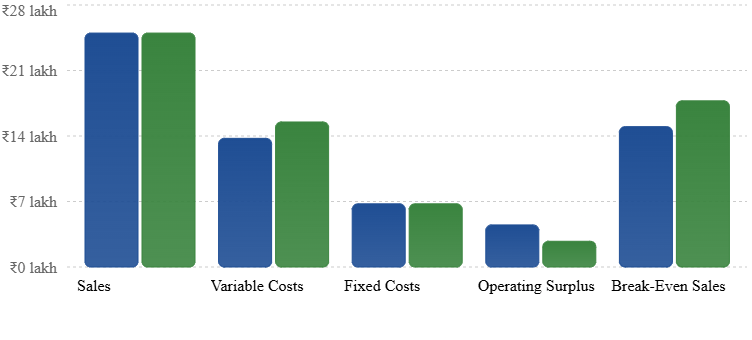
■ Base Case
■ Stress Scenario
If global cocoa prices or domestic dairy prices rise, pushing total variable costs from 55% to 62% of sales, the contribution margin falls from 45% to 38%.
Revised calculations
The revised break-even sales become:
\[ \text{Break-Even Sales}=\frac{\text{Fixed Costs}}{\text{Contribution Margin \%}} \]
=₹6,75,0000.38=₹17,76,316
At an average selling price of ₹250 per kg, the revised break-even volume is approximately 7,105 kg per month.
| Metric | Base case | Stress scenario |
| Contribution margin | 45% | 38% |
| Variable costs | ₹13,75,000 | ₹15,50,000 |
| Break-even revenue | ₹15,00,000 | ₹17,76,316 |
| Break-even volume | 6,000 kg | Approximately 7,105 kg |
| Operating surplus | ₹4,50,000 | ₹2,75,000 |
| Revenue above break-even | ₹10,00,000 | ₹7,23,684 |
Under the stress scenario, the monthly operating surplus falls by ₹1,75,000, while break-even revenue increases by approximately ₹2,76,316.
To manage ingredient price volatility and protect operating margins, the business plan recommends:
Actual profitability and loan repayment capacity will depend on ingredient prices, production yields, shelf life, distribution costs, festive demand, cold-chain performance, financing costs, and buyer payment cycles.
A confectionery business plan is a formal document outlining the operational, technical, and financial strategy for establishing or expanding a sweets, chocolate, or confectionery manufacturing business. It covers machinery requirements, recipe and batch costing, kitchen or factory layouts, food safety compliance, sourcing, marketing, and multi-year financial projections. Aviaan prepares tailored confectionery business plans covering market analysis, production planning, investment estimates, operating costs, and financial projections.
Investment depends on the business format, product range, production capacity, location, equipment, and working capital requirements. A small boutique confectionery shop may require approximately ₹15 lakh, while an automated commercial manufacturing plant may require ₹1.5 crore or more. Aviaan estimates startup capital, equipment costs, inventory needs, operating expenses, and working capital to help entrepreneurs evaluate the financial feasibility of their proposed confectionery business.
Starting a confectionery business involves researching local demand, selecting products and target customers, choosing a suitable retail or manufacturing location, sourcing ingredients, arranging food-grade equipment, and establishing hygiene and quality control procedures. Businesses must obtain the applicable FSSAI registration or license based on their activities and eligibility, along with other registrations and local approvals where required. Aviaan supports entrepreneurs with market research, business model development, operational planning, financial forecasts, and project reports tailored to their proposed confectionery venture.
Exide dealership opportunities relate to Exide products and are separate from the confectionery industry. For a confectionery business, securing corporate supply agreements or distribution partnerships involves identifying suitable buyers, presenting product samples, demonstrating consistent production capacity, maintaining food safety and quality standards, and agreeing on pricing, delivery schedules, packaging specifications, and payment terms.
Common operating formats include retail sweet shops, boutique artisanal chocolate studios, wholesale confectionery manufacturing, and direct-to-consumer online brands. Businesses may also supply hotels, restaurants, cafés, supermarkets, and corporate customers. Aviaan evaluates potential revenue streams, operating costs, pricing models, distribution strategies, and projected profitability to help entrepreneurs choose and plan an appropriate business format.
Yes. Eligible confectionery businesses may apply for business loans, equipment finance, or MSME credit facilities from banks and other financial institutions. Depending on the applicant and current scheme guidelines, financing options may include eligible MUDRA loans or credit facilities supported by the Credit Guarantee Fund Trust for Micro and Small Enterprises (CGTMSE). Lenders assess factors such as the project’s viability, promoter contribution, credit history, projected cash flow, repayment capacity, and applicable licensing requirements. Aviaan prepares project reports, investment estimates, financial projections, cash-flow forecasts, and repayment assessments to support loan applications. Financing approval remains at the lender’s discretion.
Establishing or expanding a confectionery manufacturing or retail business in India offers substantial growth potential, supported by expanding domestic retail consumption and strong festive gifting demand. Long-term profitability depends on maintaining recipe batch yields, controlling ingredient costs, and securing consistent retail distribution. A professionally engineered confectionery business plan provides the operational clarity and financial structure needed to secure bank credit, access government subsidies, and build a lasting food brand.
Connect with our specialists at Aviaan to request your fixed quote today or send your project details directly to advisory@aviaanaccounting.com.




