
Cold Storage Business Plan writing service in india 

Launch and scale a profitable cold storage and warehousing business in India with expert planning, investment strategy, and market insights from Aviaan Accounting.
COMMERCIAL EXCELLENCE

Loading...

Strategic guidance and institutional-grade solutions customized for your enterprise objectives.
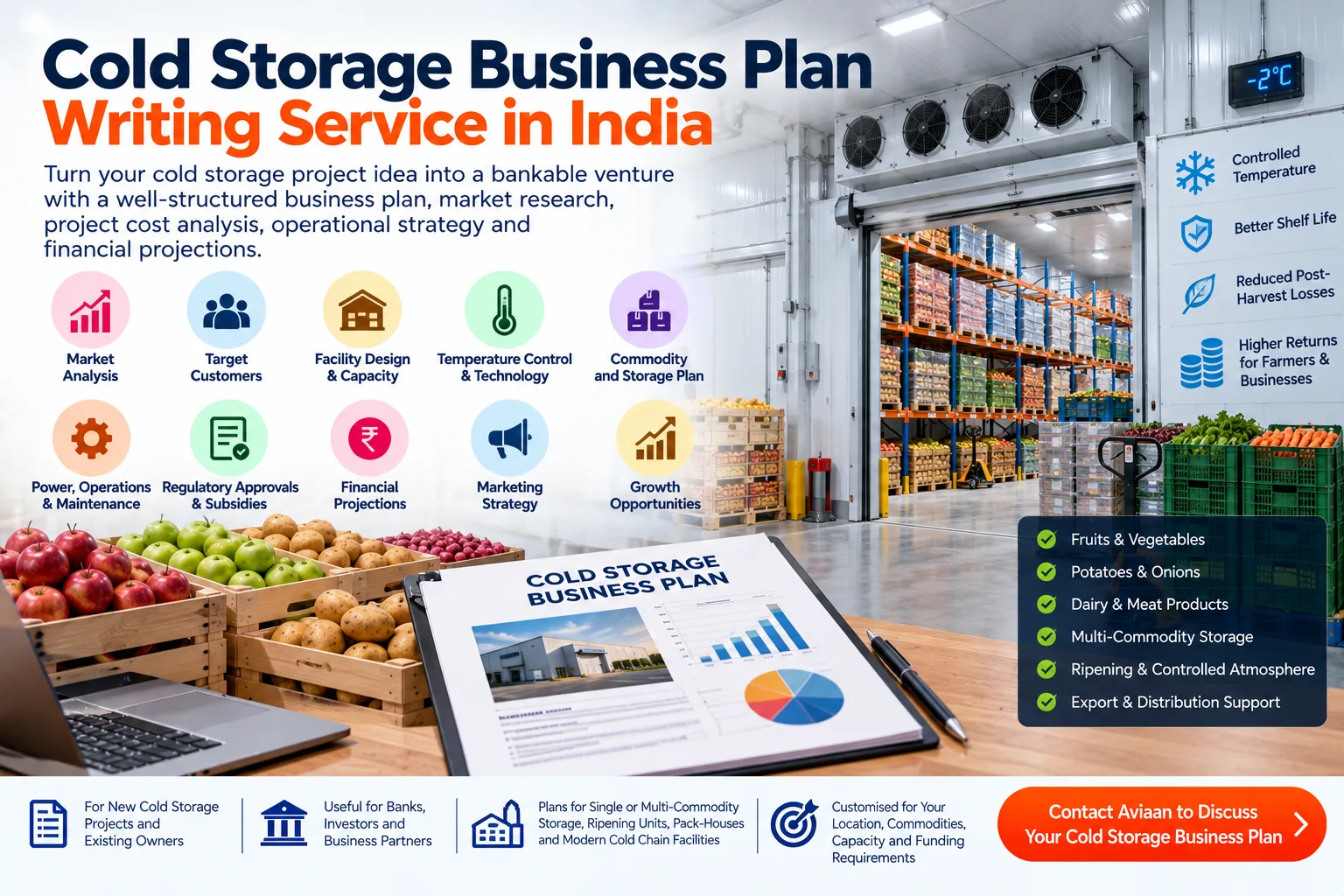
cold storage business plan

Talk to a Financial Expert

Schedule a complimentary 30-minute discovery call to discuss your enterprise’s financial trajectory.
By submitting, you agree to our Privacy Policy.

Table of Contents

A cold storage earns rent for keeping produce fresh, but it pays for power every hour of the year. Owners must fund land, an insulated building, refrigeration plant, generators, racking and handling equipment long before the first bag is loaded. After commissioning, how full the chambers stay, how much rent farmers and traders can pay, power costs and whether customers lift their stock on time decide how much profit is left.

A professional cold storage business plan turns a storage idea into a clear, bankable project. It covers the commodities to be stored, capacity and chamber design, location, customers, rental rates, power and operating costs, subsidies, project cost and expected cash flow.

A well-prepared business plan for cold storage projects also helps when approaching banks, government subsidy schemes, investors, farmer producer organisations, traders, exporters and food companies. Existing owners can use one to add chambers, convert to multi-commodity storage, add ripening or controlled atmosphere rooms or install solar power.

Aviaan Accounting prepares plans for farmers and landowners, farmer producer organisations, agri-traders, exporters, food processors and logistics companies building cold storage. Each plan ties capacity, seasons and power costs to a lender-ready financial model.

Contact Aviaan to discuss your cold storage business plan and share your site, commodities and funding needs.

Cold Storage Business Plan Writing Services In India

India's Cold Storage Industry Overview: Storage Demand, Facility Types and Business Potential

Cold storages serve farmers holding potatoes and other crops for better prices, traders and exporters storing fruits and vegetables, dairy and meat businesses, food processors, pharmacies and quick-commerce networks. Demand depends on local crop output, harvest seasons, market prices, the facility's temperature control, location, rent and reliability.

India produces large volumes of fruits and vegetables, yet post-harvest losses remain high where cold chain capacity is short. A cold storage business plan in India should combine official agricultural and horticulture data with clearly stated assumptions about the facility's catchment, commodities and seasons.

  1. Market size: Size demand in your catchment. Estimate the production of target crops within trucking distance, the share usually stored, existing storage capacity and the gap your facility can fill.
  2. Market growth: The National Horticulture Board publishes area and production data for fruits and vegetables, along with cold storage information. Use it to support volume and season assumptions.
  3. Market forecasts: No official source predicts a single facility's occupancy. Project loading and unloading month by month for each commodity, occupancy, rent per bag, tonne or pallet, and test weaker and stronger crop years.
  4. Facility segmentation: Options include single-commodity potato storages, multi-commodity cold rooms, controlled atmosphere stores for apples and other fruit, pre-cooling and pack-houses for exports, ripening chambers for bananas and mangoes, frozen storage, and pharmaceutical and dairy cold rooms.
  5. Geographic segmentation: Facilities near production belts serve farmers at harvest, while those near cities, ports and highways serve traders, processors and distributors. Compare land cost, power reliability, road access and competing storage.
  6. Customer profile: Farmers, farmer producer organisations, traders, exporters, processors, retail chains, quick-commerce firms and pharma distributors use storage very differently. Choose the mix that keeps chambers full across seasons.
  7. Customer spending: Farmers compare storage rent with the price gain from selling later, while companies compare it with the cost of spoilage. Some states regulate rent for certain crops, so check local rules before setting rates.
  8. Competitor benchmarking: Compare nearby cold storages by capacity, age, temperature control, rent, loading charges, financing support and reputation for quality and fair dealing.
  9. Industry trends: Multi-commodity and multi-temperature facilities, solar-powered and energy-efficient refrigeration, pack-houses for exports, warehouse receipt financing, organised retail and quick-commerce demand are changing the sector.
  10. Customer preferences: Customers want steady temperatures and humidity, low losses, clean and pest-free chambers, fair rent and weighing, safe stock records and quick access to their goods. The plan should show how the facility delivers these.
  11. Demand drivers: Harvest seasons, price swings between harvest and lean months, export demand, processing industry needs and growth in organised food retail drive storage demand.
  12. Government policies: Capital subsidies for cold storage are available under the Mission for Integrated Development of Horticulture through the National Horticulture Board and under schemes of the Ministry of Food Processing Industries, and the Agriculture Infrastructure Fund offers interest support on eligible loans. Storage of raw agricultural produce is exempt from GST. Check current eligibility before planning.
  13. Distribution channels: Business comes from direct farmer contracts, farmer producer organisations, traders and commission agents, exporters, processors, retail and quick-commerce firms, and bank-linked warehouse receipt financing. Each brings different rents and payment terms.
  14. Regional opportunities: Uttar Pradesh, West Bengal, Punjab and Gujarat lead potato storage, Maharashtra and Karnataka suit fruit and vegetable exports, and hill states suit controlled atmosphere storage for apples.
  15. Industry challenges: High power bills, power cuts, seasonal occupancy, regulated rents in some states, customers abandoning stock when prices crash, ageing equipment, ammonia safety and skilled labour shortages can squeeze returns.
  16. International benchmarking: Global cold chain operators offer ideas on automation, energy efficiency and multi-temperature warehousing. Their costs and rents differ, so they need adjusting for India.
  17. Business feasibility indicators: Key measures include project cost per tonne of capacity, occupancy by month, rent per tonne or bag, power cost per tonne, total operating cost, subsidy amount, debt-service coverage ratio and payback period.

A potato cold storage business plan for Agra looks very different from one for a multi-commodity facility near Nashik or a pharmaceutical cold room in Hyderabad. Commodities, location and seasons should shape the plan from the start.

Why You Need a Professional Cold Storage Warehouse Business Plan

A professional cold storage warehouse business plan helps farmers and landowners, farmer producer organisations, traders, exporters, food processors and logistics companies. Because the project needs heavy upfront spending and its chambers fill and empty with the seasons, lenders and subsidy authorities study the numbers closely.

Five cold storage-specific issues make expert planning worthwhile.

  • Term loans and subsidies: Banks, subsidy schemes and interest support programmes want the project cost, promoter contribution, loan amount, eligible components and repayment capacity set out clearly. A structured plan makes approvals smoother.
  • Customer and offtake commitments: Exporters, processors, retail chains and farmer groups want to see capacity, temperature control, quality systems and financial strength before committing their produce or signing storage contracts.
  • Capacity and chamber design: Too much single-commodity space can sit empty for months, while the right mix of chambers and temperatures can keep the facility busy across seasons. The plan sizes capacity to real demand.
  • Power and operating costs: Refrigeration power is the largest running cost, followed by labour, maintenance and insurance. The plan tests power tariffs, backup costs and energy-saving options such as solar.
  • Cold storage risks: Crop failures, price crashes that lead customers to abandon stock, power cuts, equipment breakdowns, ammonia leaks and regulated rents can hit income. Scenario testing shows how much the project can absorb.

Aviaan builds each plan around your site, commodities, capacity and funding structure.

Discuss your cold storage project with Aviaan to agree the scope of your business plan.

How to Write a Cold Storage Business Plan in India

If you are working out how to write a cold storage business plan, follow seven steps: choose commodities and customers, assess the site, design capacity and chambers, plan equipment and operations, map approvals and subsidies, build the numbers and summarise. The same order works for a cold storage startup business plan and for a wider cold chain business plan that adds pack-houses, ripening or transport.

  1. Choose commodities and customers. Decide which crops or products you will store, such as potatoes, onions, fruits, vegetables, dairy, frozen foods or medicines, and who will use the space in each season.
  2. Assess the site. Check land title and use, distance from farms or markets, road access, power supply and reliability, water availability and nearby competing storages.
  3. Design capacity and chambers. Fix total capacity, number and size of chambers, temperature and humidity ranges, any controlled atmosphere or ripening rooms, and pre-cooling or grading areas.
  4. Plan equipment and operations. Select refrigeration systems, insulation panels, generators, racking, forklifts, weighbridges, monitoring systems and any solar power, and plan loading, stock records, staffing and maintenance.
  5. Map approvals and subsidies. Confirm building approvals, state cold storage licence or registration where required, factory and fire safety approvals, pollution consent, FSSAI for food storage, warehouse registration for receipt financing, and eligible subsidy and interest support schemes.
  6. Build the financial model. Estimate land, civil work, refrigeration and equipment, pre-operative costs, subsidy, loan and equity, occupancy and rent by month, power, labour, maintenance, insurance and working capital.
  7. Write the executive summary last. Once the numbers hold, sum up the commodities, capacity, customers, project cost, funding plan and expected returns.

Ask Aviaan to prepare your cold storage business plan for a potato storage, multi-commodity facility, export pack-house or pharma cold room.

How Aviaan Can Help You Launch and Secure Funding for Your Cold Storage

Aviaan treats a cold storage plan as a model of seasons, chambers and power. Whether you are building a single-crop store or need a multi commodity cold storage business plan, we connect your commodities, capacity and customers to projections a lender or subsidy authority can test month by month.

  • Lender and scheme-ready documents: Plans suited to bank term loans, horticulture and food processing subsidy applications, interest support schemes, investors and storage contracts with traders, exporters and processors.
  • Season-level projections: A cold storage business plan with financial projections that models loading, occupancy and unloading for each commodity and chamber across the year, with rent, power and operating costs for each month.
  • Capex, subsidy and cash planning: Project cost split into subsidy-eligible components, subsidy timing, debt sizing, debt-service coverage, power and backup costs, GST treatment of exempt and taxable storage, and reserves for slow seasons.
  • Support across India: Plans for facilities in any state, reflecting local crops, power tariffs, regulated rents and subsidy rules.

Our Simple 5-Step Process

  1. Discovery call: We discuss your site, commodities, capacity, customers and how the plan will be used.
  2. Information gathering: We collect details on ownership, land, civil and refrigeration quotes, power connection, expected customers, rent levels and available funds.
  3. Plan and model preparation: We write the plan and build projections with every assumption clearly stated.
  4. Review and changes: We walk you through the draft and adjust capacity, chamber mix, rent or costs as agreed.
  5. Final delivery: You receive the finished plan and financial model in the format your lender, investor or subsidy authority needs.

Learn more about Aviaan's business plan services, or see our frozen food business plan page if you plan to add processing alongside storage.

Book a discovery call with Aviaan to discuss your cold storage and receive a fixed-fee quotation.

What Aviaan's Cold Storage Business Plan Includes

Whether it covers a potato cold storage business plan or a multi-temperature facility, a strong plan shows how the storage will stay full across seasons, keep produce in good condition, control power and operating costs, collect rent on time and repay its loans comfortably.

Aviaan adapts the following ten components to your facility.

  1. Executive summary: The commodities, capacity, location, customers, project cost, subsidy, funding plan and headline returns on one page.
  2. Promoter profile and ownership: Promoters, legal structure, farming, trading, food or logistics experience and management roles.
  3. Catchment and commodity analysis: Crop production in the catchment, harvest and storage seasons, price patterns, existing storage capacity and the gap your facility fills.
  4. Services, rent and terms: Storage by bag, tonne or pallet, seasonal and monthly rates, loading and handling charges, pre-cooling, grading, ripening or packing services, and rent collection terms.
  5. Customer, financing and partner arrangements: Farmer and farmer producer organisation tie-ups, trader and exporter contracts, processor and retail agreements, warehouse receipt financing with banks and insurers.
  6. Operations and staffing: Loading and unloading schedules, stock records, temperature and humidity monitoring, quality checks, pest control, safety routines and staff roles.
  7. Building and refrigeration infrastructure: Insulated chambers, refrigeration plant, generators, solar power, racking, forklifts, weighbridge, pre-cooling and ripening rooms, and monitoring systems.
  8. Compliance roadmap: Building and fire approvals, state cold storage licence or registration where applicable, factory and pollution consents, ammonia safety rules, FSSAI for food products, warehouse registration and GST treatment of exempt and taxable storage.
  9. Financial projections: Project cost, subsidy and its timing, debt and equity, occupancy and rent by month, power and operating costs, profit and loss, cash flow, balance sheet, debt-service coverage and payback. Peak and lean seasons are modelled separately so cash needs are clear.
  10. Risk and contingency planning: Crop failures, price crashes and abandoned stock, power cuts, equipment breakdowns, ammonia leaks, regulated rents and customer defaults, each with a planned response.

The same framework supports a fruits and vegetables cold storage business plan, a controlled atmosphere storage business plan, a ripening chamber business plan, a pharmaceutical cold storage business plan and a solar cold storage business plan. The emphasis shifts with commodities, temperatures, capacity and customers.

Request a fixed-fee quote for your cold storage business plan to discuss your facility and goals.

Case Study: Business Plan for a Cold Storage Expansion in Nashik

Drawn from Aviaan's agri-infrastructure planning work. Client names and details changed to protect confidentiality.

Problem

The owner of a 3,000 tonne multi-commodity cold storage near Nashik, storing onions, pomegranates and vegetables for local traders, wanted to add pre-cooling rooms and controlled atmosphere chambers to serve grape exporters. His bank asked for a term loan proposal that showed the existing storage and the new export block separately. His draft combined both and assumed the export block would stay full all year, although grape exports run mainly from January to April. It left out the registration and quality requirements for export pack-houses and the higher power load of pre-cooling. It also planned to charge 18% GST on all services and claim input tax credit, although storing and packing raw agricultural produce is exempt from GST.

Solution

  • Aviaan reviewed three years of occupancy by commodity and month, and studied grape, pomegranate and onion volumes and export demand in the Nashik belt.
  • We built separate models for the existing storage and the export block, with loading, occupancy and rent for each commodity and season.
  • We costed pre-cooling and controlled atmosphere equipment, extra power and backup, pack-house requirements and staffing, and treated GST on these costs as part of project cost because the storage income is exempt.
  • We mapped eligible components for horticulture and cold chain subsidies, and added pack-house registration, factory and fire approvals and ammonia safety to the compliance roadmap.
  • We built ten-year projections, including balance sheets and debt-service coverage, in the format the bank asked for.

Result

He received a complete cold storage business plan with one consistent financial model. The analysis led him to start with pre-cooling and two controlled atmosphere chambers, sign seasonal contracts with three grape exporters, fill the export block with pomegranates and onions outside the grape season, and apply for a capital subsidy on the eligible equipment. He submitted a single, phased plan to his bank.

Real-World Example: Planning a Potato Cold Storage near Agra

Here is a worked cold storage business plan sample for a family building a 5,000 tonne potato cold storage near Agra, Uttar Pradesh, serving local farmers and traders. These are sample numbers, not a forecast.

  • Project cost: about ₹9,000 per tonne of capacity, or ₹4.5 crore in total, including GST on construction and equipment
  • Rent: about 1,00,000 bags of 50 kg at 90% occupancy, or 90,000 bags at ₹200 per bag for the season, giving ₹1.8 crore a year
  • Operating costs for power, labour, maintenance and refrigerant, insurance and administration: about ₹1.01 crore a year, leaving about ₹79 lakh before debt
  • Debt of 65% (₹2.93 crore) at 10% over 8 years: annual repayment of about ₹55 lakh, giving a debt-service coverage ratio of about 1.44 and a simple payback of about 5.7 years before any subsidy

Storage of raw potatoes is exempt from GST, so the facility charges no GST on rent and cannot claim back the GST paid on construction and equipment. That GST is included in the project cost.

Next, the plan stress-tests one risk. A bumper crop sends potato prices crashing, and farmers leave about a fifth of their stock unclaimed and unpaid at the end of the season. Power costs also rise. Income before debt falls to about ₹43 lakh and the coverage ratio drops to about 0.78, below what the loan needs.

The plan shows the fix: collect part of the rent in advance at loading, link customers to bank loans against warehouse receipts so stored stock carries value even in a bad year, fill empty chambers between seasons with seeds, spices and dry produce, and install rooftop solar to cut power costs by about a quarter. With a debt service reserve, these bring the coverage ratio back to about 1.24 and keep repayments on time. A capital subsidy, if approved, would reduce the loan further. A fuller model should also account for tax, refrigeration plant replacement, rent regulation and the timing of subsidy release.

Frequently Asked Questions

1. What is a cold storage business plan?

It is a written plan, backed by a financial model, covering the commodities, capacity, chamber design, location, customers, rent, power and operating costs, subsidies, project cost and projected cash flow by season. It helps promoters present the project to banks, subsidy authorities, investors and large customers.

2. How much investment is needed to set up a cold storage in India?

It depends on capacity, commodities, temperature range and location. Main costs include land, insulated building, refrigeration plant, generators, racking and handling equipment, weighbridge, monitoring systems, GST on construction and equipment, pre-operative expenses and working capital. Capital subsidies can reduce the promoter's share if the project qualifies.

3. How do you start a cold storage business in India?

Study the crops and customers in your area, choose a site with good roads and reliable power, and decide on capacity and chamber types. Then get quotes from refrigeration and civil contractors, check subsidy and interest support schemes, obtain approvals, arrange a bank loan and prepare month-by-month financial projections before construction.

4. What should a cold storage business plan sample include?

A useful sample covers the catchment and commodity analysis, capacity and design, customers and rent, operations, compliance, subsidies and financial projections. It should also explain the assumptions behind occupancy by month, rent, power cost, debt-service coverage and payback.

5. Is a business plan for small cold storage projects worth preparing?

Yes. A business plan for small cold storage units, such as farm-gate cold rooms or solar cold rooms run by farmer groups, shows whether local produce and rent can cover power and loan costs, and helps when applying for subsidies.

6. Can I use a cold storage business plan for bank loan applications?

Yes. A cold storage business plan for bank loan applications shows the project cost, promoter contribution, subsidy, loan amount and tenure, seasonal income, debt-service coverage and security. The bank still makes its own technical and financial assessment before deciding.

7. What licences does a cold storage need in India?

Common requirements include building and fire approvals, factory licence where applicable, pollution control consent, state cold storage licence or registration in states that require it, ammonia safety compliance, FSSAI registration for storing food products, warehouse registration if offering receipt-based financing and GST registration. Rules vary by state.

8. How much does Aviaan charge for a cold storage business plan?

Aviaan gives a fixed-fee quote after a free initial consultation. The fee depends on capacity, number of commodities and chamber types, subsidy work, depth of financial modelling and how the plan will be used. Contact Aviaan for a tailored quote.

Conclusion

A cold storage succeeds when the right commodities, a well-designed facility, steady customers and tight control of power costs work together. A professional cold storage business plan shows what the facility will cost including GST, how full it will be in each season, what rent it can earn, how subsidies and loans fit together, and how comfortably it can repay its debt. Whether you are building a potato store, a multi-commodity facility, an export pack-house or a pharmaceutical cold room, Aviaan can prepare a plan built around your site, customers and funding goals.

Contact Aviaan to discuss your cold storage business plan or email advisory@aviaanaccounting.com for a consultation and fixed-fee quotation.

Talk to an Expert

Schedule a complimentary 30-minute discovery call to discuss your requirements.

By submitting, you agree to our Privacy Policy.

Table of Contents

Need Immediate Help?

Our advisory team is ready to assist you.

Let's Build Your Business Success Together

Our senior partners are available to evaluate your current financial structure and identify opportunities for optimization and risk reduction.

Sector Expertise

Our advisory assignments span a wide range of industries, including:

Healthcare
Hospitality
Restaurants & F&B
Retail
Technology & SaaS
Fintech
Real Estate
Manufacturing
Logistics
Education
Automotive
Consumer Products
Professional Services
Renewable Energy
E-commerce
Beauty & Wellness

Each sector requires different demand drivers, economics, competitive factors and valuation considerations. Our analysis is structured accordingly.

Industries We Serve

Tailored financial strategies for specialized sectors.

Real Estate

Healthcare

Manufacturing

Technology

Retail & E comm

Logistics

Services Offered by Aviaan

Feasibility Study

Independent verification of financial statements to ensure transparency and trust.

Business Plan

A comprehensive analysis to evaluate the commercial, technical, and financial viability of a proposed business or project before investment.

Business Valuation

An objective assessment of a company, asset, or investment to determine its fair market value for transactions, reporting, or strategic decisions.

Due Diligence

A detailed financial review to assess risks, validate performance, and ensure informed decision-making in transactions.

Accounting

End-to-end financial recording, reporting, and compliance services to maintain accurate books and support business decision-making.

Market Research

Launching a new venture, expanding into a new geography, raising capital, or entering a new segment, robust market research is critical.

Need Immediate Help?

Our advisory team is ready to assist you with your urgent financial queries.

Services Offered by Aviaan

Feasibility Study

Independent verification of financial statements to ensure transparency and trust.

LEARN MORE →

Business Plan

A comprehensive analysis to evaluate the commercial, technical, and financial viability of a proposed business or project before investment.

LEARN MORE →

Business Valuation

An objective assessment of a company, asset, or investment to determine its fair market value for transactions, reporting, or strategic decisions.

LEARN MORE →

Due Diligence

A detailed financial review to assess risks, validate performance, and ensure informed decision-making in transactions.

LEARN MORE →

Accounting

End-to-end financial recording, reporting, and compliance services to maintain accurate books and support business decision-making.

LEARN MORE →

Market Research

Launching a new venture, expanding into a new geography, raising capital, or entering a new segment, robust market research is critical.

LEARN MORE →

Ready to Speak with an Expert?

Partner with Aviaan Advisory today to unlock your business’s full potential. Our team of experts is here
to provide tailored solutions and guide you every step of the way.

