


Fine dining is a service-led restaurant model in which food quality, hospitality, atmosphere and consistency are central to the customer experience. The concept may be built around a celebrated chef, a regional cuisine, a tasting menu, premium ingredients, a distinctive beverage programme or a carefully curated setting.
A fine dining restaurant needs more than an attractive interior and an experienced chef. It needs a clear concept, a defined customer base, a carefully designed menu, reliable suppliers, trained staff and financial planning that reflects the cost of delivering a premium dining experience. A structured fine dining restaurant business plan brings these elements together.
India offers a wide range of potential settings for premium dining concepts, from established metropolitan markets to destinations with strong hospitality and tourism activity. However, the opportunity for an individual restaurant depends on its location, target customers, average spend, competition, lease terms and operating model. A business plan helps assess these factors before substantial capital is committed.
Aviaan supports entrepreneurs, hospitality groups, chefs and investors who need a practical plan for launching, expanding or financing a fine dining restaurant. Our work can cover market research, concept development, operating strategy, investment requirements, revenue assumptions and financial projections.
Whether you are planning a chef-led tasting-menu restaurant, a premium Indian cuisine concept, a luxury steakhouse, a gourmet bistro or a restaurant with private dining facilities, Aviaan can help turn your concept into a structured business proposal.
Planning a premium dining concept? Contact Aviaan to discuss your business plan requirements.
The market assessment for a fine dining restaurant should focus on the location, spending capacity and dining preferences of its intended customers. National hospitality trends can provide context, but they cannot replace research into the specific neighbourhood and customer segment the restaurant intends to serve.
A useful market study should assess these 17 factors:
Official resources such as the Ministry of Tourism, Ministry of Statistics and Programme Implementation and Food Safety and Standards Authority of India can support research into tourism, official statistics and food safety obligations. Local field research and location-specific quotations remain essential to a credible restaurant plan.
A market assessment should end with a clear decision: proceed with the proposed concept, revise its positioning, test a smaller format or reconsider the location.
A professional fine dining business plan helps the founder evaluate the business before signing a lease, committing to expensive interiors or hiring a full team. It connects the creative vision with the commercial decisions needed to operate consistently.
1. To validate the concept. Market research helps identify the target customer, competitive position, cuisine, price range and dining occasion. It can also reveal when a concept needs a narrower menu or a different location.
2. To estimate the full investment. Restaurant costs extend beyond the visible fit-out. The plan should account for deposits, design, kitchen installation, pre-opening salaries, recruitment, launch marketing, initial inventory and working capital.
3. To develop a workable pricing strategy. Menu prices must reflect ingredient costs, portion sizes, preparation time, waste, labour requirements and the value customers place on the experience. Pricing should be supported by both cost calculations and competitor research.
4. To plan staffing and service. Fine dining depends on coordination between the kitchen, front-of-house team, reservations and management. The business plan should establish staffing assumptions, training needs, service standards and reporting responsibilities.
5. To support financing discussions. Investors and lenders typically need to understand the funding requirement, use of funds, revenue model, projected cash flow, key risks and repayment or return assumptions. A well-organised plan makes these assumptions easier to review.
6. To manage cash flow. A restaurant may face significant pre-opening expenses before it begins earning revenue. Financial projections help estimate the cash needed to cover the launch period and slower trading periods.
7. To measure performance. A clear plan defines operating indicators such as average spend, covers, table utilisation, food cost percentage, labour cost, guest feedback and monthly cash position. Management can use these measures to compare actual performance with the original assumptions.
8. To test alternative formats. A plan can compare a standalone restaurant with a hotel partnership, a smaller dining room, a private dining model or a phased launch. This helps founders assess trade-offs before making a long-term commitment.
Aviaan can prepare a plan around your concept and intended use, whether that is internal decision-making, investor presentations, lender discussions or expansion planning. The depth of research and financial modelling should match the scale and complexity of the project.
Discuss your project with Aviaan: business plan services can help you define the scope of support required.
A fine dining restaurant plan should be built around evidence, realistic operating assumptions and the specific needs of the restaurant. The following seven steps provide a practical structure.
1. Define the restaurant concept and customer. Describe the cuisine, service style, price positioning, capacity, ambience and reason customers would choose the restaurant. Identify the core customer groups and the occasions the restaurant intends to serve.
2. Research the local market. Assess the target neighbourhood, comparable restaurants, menu prices, customer feedback, accessibility and rental costs. Speak with potential customers and use local research to validate demand. Avoid treating general hospitality trends as proof that a particular restaurant will succeed.
3. Develop the menu and pricing model. Create a sample menu with portion sizes, ingredient specifications and estimated recipe costs. Account for preparation time, waste, seasonal availability and supplier reliability. Compare proposed prices with both the cost model and the experience offered by relevant competitors.
4. Plan the premises, kitchen and service operations. Establish the required seating capacity, kitchen workflow, storage, refrigeration, utilities, guest facilities and service areas. Assess whether the premises can support the concept and applicable safety requirements before committing to a lease.
5. Calculate startup costs and working capital. Prepare a detailed schedule covering deposits, professional fees, fit-out, kitchen equipment, furniture, technology, licences, recruitment, training, opening inventory and pre-launch marketing. Estimate ongoing operating costs and the cash reserve required during the ramp-up period.
6. Build financial projections and test feasibility. Forecast sales using covers, occupancy, table turnover, operating days and average spend. Model food and beverage costs, payroll, rent, utilities, marketing, maintenance, taxes and financing costs as appropriate. Test lower sales, higher costs and slower customer acquisition to understand how sensitive the business is to changes.
7. Write the executive summary last. Summarise the concept, target market, competitive position, funding requirement, operating model and financial outlook after the detailed plan is complete. Tailor the summary to its audience, whether a lender, investor, landlord or internal management team.
The final document should make the assumptions visible. For example, if projected revenue depends on achieving a certain number of covers each evening, the plan should show how that number was calculated and whether the kitchen and service team can handle it.
Compliance should be checked for the proposed premises and business model. The FSSAI and its FoSCoS licensing and registration portal are starting points for checking food business requirements. Local municipal, fire, building, labour and other applicable requirements should also be verified with the relevant authorities.
Aviaan helps hospitality entrepreneurs convert a restaurant concept into a business plan with a clear market rationale, operating model and financial structure. The engagement can be tailored to a new restaurant, a premium dining extension, an investor proposal or an existing restaurant planning expansion.
Our support can include:
The scope can be adjusted to the information available. Where vendor quotations, lease terms or local market data are missing, the plan should identify those gaps and use clearly labelled planning assumptions until the information is confirmed.
The result is a structured planning document, not a guarantee of financing, sales or profitability. The value lies in making the commercial assumptions clear enough to assess, challenge and improve.
Contact Aviaan to discuss a business plan for your proposed fine dining restaurant.
The contents of the plan depend on the project's stage and purpose. A full business plan for a new restaurant will commonly include these ten sections.
1. Executive summary: A concise overview of the concept, customer proposition, location, funding requirement, business objectives and financial outlook. This section is prepared after the other sections have been developed.
2. Business and concept description: The restaurant's name, ownership structure, cuisine, service format, proposed capacity, positioning and customer experience. It explains what makes the concept distinct without relying on unsupported claims.
3. Market research and customer analysis: The target market, customer segments, dining occasions, relevant local demand indicators, competitor assessment and research limitations. The analysis should be specific to the proposed location.
4. Menu and pricing strategy: Sample menu categories, portion and recipe-cost assumptions, pricing logic, sourcing considerations, dietary requirements and menu engineering priorities. The plan can also assess a tasting menu, à la carte offering or seasonal menu where relevant.
5. Marketing and sales strategy: Brand positioning, website, reservation process, local partnerships, public relations, launch activities, customer retention and event enquiries. Marketing targets should be connected to an affordable budget and measurable results.
6. Operations and service plan: Premises, seating capacity, kitchen layout requirements, purchasing, stock control, food safety, service sequence, cleaning, maintenance, reservations and quality control. It should identify operational dependencies and the responsibilities of key staff.
7. Management and staffing: Organisation structure, chef and management responsibilities, front-of-house staffing, recruitment, training, payroll assumptions and service standards. Staffing levels should be appropriate to the expected covers and service style.
8. Startup costs and funding requirements: Premises deposit, design, fit-out, equipment, furniture, technology, professional fees, pre-opening expenses, opening inventory and working capital. Funding sources and the intended use of funds should be stated clearly.
9. Financial projections and feasibility: Revenue forecasts, cost assumptions, projected profit and loss, cash flow, startup funding, break-even analysis and scenario testing. The model should show how changes in customer volume, average spend or costs affect financial performance.
10. Risk assessment and implementation plan: Major commercial and operational risks, mitigation measures, launch milestones, dependencies and performance indicators. This section helps management turn the plan into an actionable work programme.
For investor or lender discussions, supporting schedules may include quotations, proposed lease terms, founder profiles, supplier information, market research and detailed financial assumptions. Any external figures should be traceable to reliable sources, while unconfirmed inputs should remain clearly identified as assumptions.
The plan can also be adapted for related concepts, including a luxury restaurant business plan, an upscale restaurant business plan, a gourmet restaurant, a steakhouse, a fine dining bistro or a restaurant with private dining facilities. The underlying framework remains similar, but the customer profile, menu economics, service requirements and revenue assumptions should reflect the chosen format.
Drawn from Aviaan's restaurant business planning approach. Client names and details changed to protect confidentiality.
A restaurant operator in Coimbatore wanted to establish a fine dining restaurant serving premium food and beverages to families, professionals and corporate customers. The owner needed a business plan to evaluate the initial investment, assess the restaurant's profitability and support discussions with potential lenders or investors.
The existing estimates covered kitchen equipment, furniture and interior design but did not fully account for food wastage, chef and service staff costs, equipment maintenance, utilities, customer acquisition expenses or fluctuations in daily covers. The owner needed a financial model showing revenue by dining service, food costs, monthly operating expenses, break-even sales and the working capital required to manage the restaurant during its initial operating period.
Aviaan structured the business plan around fine dining services, identifying the proposed menu, target customer segments, pricing strategy and restaurant operating requirements.
We developed setup-cost estimates covering kitchen equipment, refrigeration, interior fit-outs, dining furniture, tableware, point-of-sale systems and other pre-opening expenses.
We prepared food and beverage costing estimates covering ingredients, kitchen consumables, wastage, chef and kitchen staff costs, supplier payments and menu-level gross margins.
We prepared a working capital schedule connecting daily sales, customer payments, supplier credit, employee salaries, rent, utilities and other recurring operating expenses.
We modelled different customer footfall, average billing and food-cost scenarios to assess how lower table occupancy, rising ingredient prices and discounting could affect monthly cash flow.
We prepared projected profit and loss statements, cash flow, balance sheets, break-even calculations and funding requirement estimates to support the proposed business plan and financing discussions.
The completed business plan and financial model provided a structured view of the proposed restaurant, expected revenue, operating expenses and funding requirements. The financial analysis highlighted the importance of maintaining food-cost controls, achieving sufficient table occupancy, setting menu prices that support target margins and managing fixed operating commitments.
The business could use the plan to evaluate its initial investment, estimate the monthly sales required to cover operating expenses and present its financial assumptions consistently during financing discussions. The analysis also helped identify the potential impact of lower customer footfall, food wastage and increases in ingredient prices on restaurant profitability. Any lending or investment decision would remain with the relevant lender or investor.
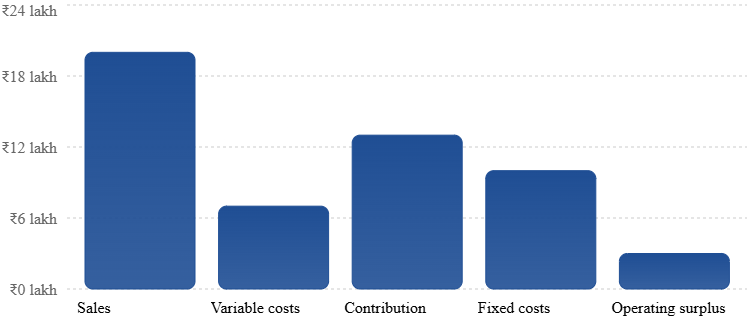
Here is a worked example for an entrepreneur planning to establish a fine dining restaurant in Pune, serving premium meals to families, professionals and corporate customers. These are sample numbers, not a forecast.
Fine Dining Restaurant — Monthly Financial Snapshot
Illustrative monthly figures in ₹ lakh. Operating surplus is before financing costs, taxes and other excluded expenses.
Risk scenario: Suppose higher ingredient prices, food wastage and promotional discounts reduce the contribution margin from 65% to 55%. Monthly break-even sales then increase to approximately ₹18.18 lakh.
Break-evensales=₹10lakh0.55=₹18.18lakh
Fine Dining Restaurant — Break-Even Analysis
Illustrative monthly sales and total operating costs in ₹ lakh. The baseline assumes a 65% contribution margin; the risk scenario assumes 55%.
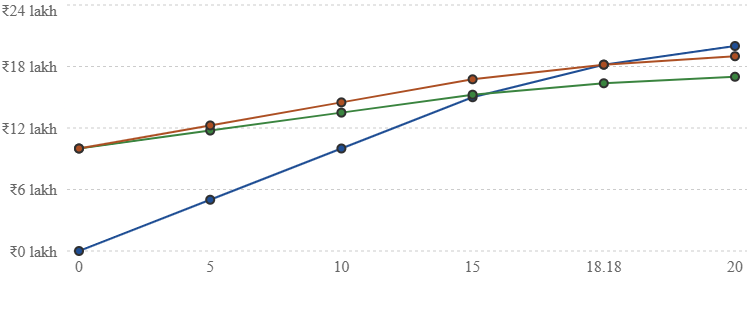
■ Sales revenue
■ Total costs — baseline
■ Total costs — risk scenario
At monthly sales of ₹20 lakh, the business would generate ₹11 lakh in contribution and retain ₹1 lakh after the assumed fixed costs, before financing costs, taxes and other excluded expenses. This compares with ₹3 lakh remaining under the original assumptions.
Planning response: The business plan can recommend monitoring food costs by menu item, reviewing supplier quotations, tracking table occupancy and average customer bills, controlling food wastage and setting menu prices based on ingredient costs and target margins. It can also help management assess staffing levels and marketing expenditure against actual customer demand. These controls help management evaluate profitability and cash-flow risks but cannot guarantee a particular financial result.
A fine dining restaurant business plan is a document explaining the restaurant's concept, target customers, market position, menu, operations, investment requirements and financial outlook. It helps founders assess feasibility and communicate the business case to potential investors, lenders and partners.
Investment depends on the city, premises, seating capacity, interior specification, kitchen equipment, menu and working capital. Prepare a location-specific budget using actual quotations, lease terms and staffing costs rather than relying on a single national estimate.
Start by defining your concept and target customer, researching locations and competitors, costing the menu and estimating startup funding. Then verify applicable permissions, prepare operational and financial plans, secure suitable premises and build a trained team before opening.
A sample or free template can help organise the sections, but it cannot validate your local demand, pricing, costs or funding needs. Use a template as a starting structure, then replace generic assumptions with research and restaurant-specific financial calculations.
Potential formats include contemporary Indian dining, a chef-led tasting menu, an upscale bistro, a gourmet restaurant, a luxury steakhouse or a restaurant with private dining. Choose based on local customer research, your team's expertise, investment capacity and operating feasibility.
Yes. A plan can present the project, funding requirement, proposed use of funds, financial projections, cash flow and key risks. Loan approval is not guaranteed; the lender will assess eligibility, repayment capacity, collateral where relevant and supporting documents.
A well-researched fine dining restaurant business plan helps entrepreneurs assess market demand, define a premium dining concept, calculate investment requirements and test financial feasibility before committing capital. Aviaan can support the planning process with market analysis, operational strategy and financial projections tailored to your restaurant's goals.
Ready to develop your restaurant concept? Contact Aviaan or email advisory@aviaanaccounting.com to discuss your business plan.




