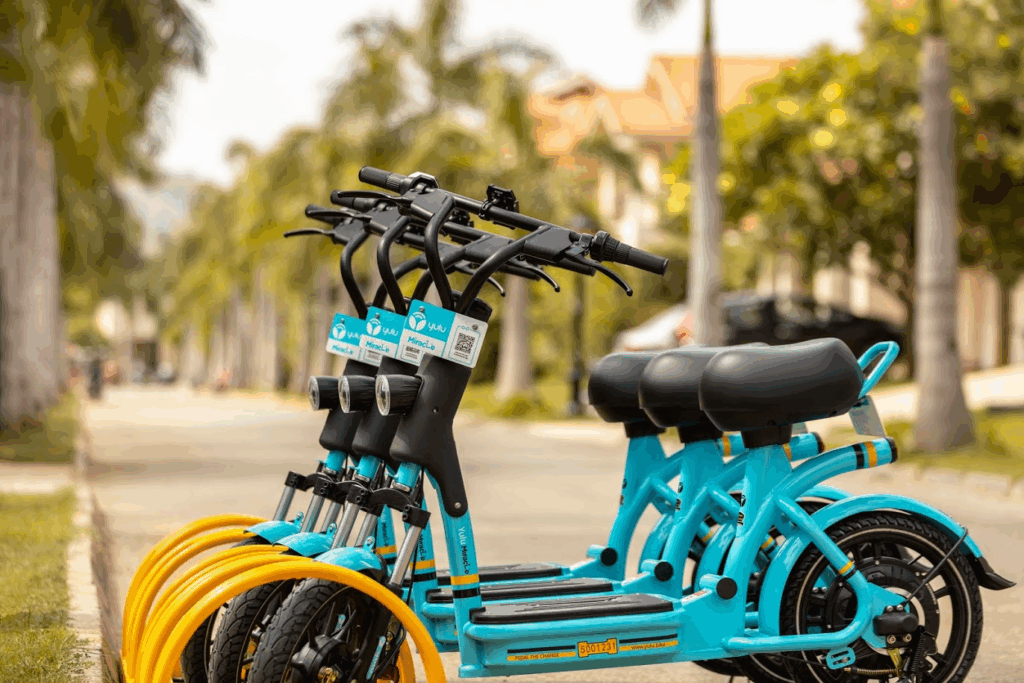
Business Plan for Bike/Scooter Sharing Business in South Africa
Micromobility in South Africa is set for massive growth. Success in bike/scooter sharing hinges on securing municipal permits, managing high asset depreciation, and optimizing fleet rebalancing/charging logistics.
December 13, 2025
10 min read
COMMERCIAL EXCELLENCE
Loading...
Strategic guidance and institutional-grade solutions customized for your enterprise objectives.
Talk to a Financial Expert
Schedule a complimentary 30-minute discovery call to discuss your enterprise’s financial trajectory.
By submitting, you agree to our Privacy Policy.
Table of Contents
The micromobility sector—encompassing shared bicycles and e-scooters—represents one of the most transformative, yet challenging, urban business opportunities in South Africa. Globally, the micromobility market is projected to reach hundreds of billions of dollars, and the Middle East & Africa region alone is expected to see its market size double by 2030. In South Africa, the growth is fueled by severe urban congestion, rising fuel costs, and a strong push for sustainable, ‘load-shedding-proof’ transport alternatives. A Bike/Scooter Sharing Business aims to solve the critical "last-mile problem" in cities like Cape Town, Johannesburg, and Durban, connecting public transport hubs to final destinations (workplaces, universities, tourist sites).However, unlike traditional business models, micromobility is characterized by an extreme operational and regulatory risk profile: high upfront CAPEX for fleets (especially imported e-scooters/e-bikes), accelerated asset depreciation due to theft and vandalism, complex insurance/liability requirements due to the novelty of the vehicle type, and the absolute necessity of securing municipal permits and geofencing agreements for dockless operations. A successful Business Plan must be a sophisticated financial and logistical blueprint, balancing technological efficiency with hyperlocal operational realities.
Strategic Pillars of the Micromobility Business Plan
A successful South African micromobility business requires rigor across four unique areas:
1. Market Entry and Geofencing Strategy
Niche Definition: Define the core offering (e.g., standard dockless bikes vs. high-value seated e-scooters vs. electric cargo bikes for B2B logistics). Dockless services generally offer lower operational costs but face greater regulatory scrutiny.
Target Operating Zone (Geofencing): The plan must specify the initial launch area (e.g., university campuses, high-density CBDs, coastal tourist strips). The financial model is highly sensitive to the Geofenced Zone's population density, median income, and existing transport infrastructure.
Permit and Municipality Negotiation: This is the primary hurdle. The plan must detail the strategy for engaging local government (e.g., City of Cape Town, City of Johannesburg) to secure essential operating permits, addressing concerns regarding sidewalk congestion, visual pollution, and safety.
2. Fleet Management and Total Cost of Ownership (TCO)
CAPEX and Vehicle Selection: Detail the capital expenditure for the fleet. E-scooters/e-bikes are specialized industrial assets. The plan must justify the choice of vehicle (e.g., higher quality, longer-life batteries, GPS tracking) and model the impact of high import duties and ZAR/USD volatility on initial cost.
Depreciation and Lifespan: Unlike a car, a shared scooter/bike has a limited operational lifespan (often 12-18 months in hostile urban environments). The model must utilize an accelerated depreciation schedule, factoring in losses from theft, vandalism, and rapid wear.
Operations and Logistics (Rebalancing & Charging): This is the largest operational cost. The plan must outline the rebalancing strategy (moving vehicles from low-demand to high-demand zones) and the charging network (centralized depot charging vs. third-party 'charger' network), detailing the required number of full-time "runners" and charging vans.
3. Financial Modeling and Key Operating Metrics
The financial viability is dictated by utilization, not fleet size alone:
Revenue Model: Structure the pricing (Unlock Fee + Per-Minute Fee). The model must calculate the Average Revenue Per Vehicle Per Day (ARPV/D) and the Average Trip Length/Time.$$\text{ARPV/D} = \text{Total Daily Revenue} / \text{Fleet Size}$$
Break-Even Utilization: Determine the minimum number of trips per vehicle per day required to cover the daily operating cost (including depreciation, rebalancing, charging, and insurance).
Key Risk Cost Centers: Explicitly budget for Maintenance/Repair Cost Per Trip (CPT) and Fleet Loss Rate (Theft/Damage). A 5% monthly loss rate can bankrupt the operation if not managed.
4. Insurance, Liability, and Safety Protocol
Commercial Insurance: The plan must secure specialized insurance, including Asset/Vehicle Insurance (theft/damage) and, most critically, Public Liability Insurance to cover third-party injury or property damage caused by riders. South African insurers may require special underwriting for this new class of vehicle.
Rider Safety and Compliance: Detail in-app safety features, geo-fencing speed limits (e.g., 15 km/h in pedestrian zones), and mandatory helmet policies (where enforced by local bylaws) to mitigate risk and demonstrate responsibility to municipalities.
How Aviaan Can Help Master the Bike/Scooter Sharing Business Plan
Aviaan specializes in applying rigorous financial engineering and regulatory expertise to high-growth, asset-intensive, and operationally complex sectors like micromobility. For a Bike/Scooter Sharing Business in South Africa, our service focuses on transforming the immense operational uncertainty into a predictable, investor-ready model by de-risking the three core challenges: CAPEX/TCO, Regulatory Compliance, and Operational Logistics Cost.
I. Financial Engineering for Total Cost of Ownership (TCO) and Break-Even
The high-velocity nature of the asset and its rapid depreciation make TCO modeling non-negotiable for securing investment:
CAPEX and Currency Risk Modeling: We build a detailed CAPEX schedule for the fleet, incorporating imported costs (USD/EUR) and applying a sensitivity analysis to ZAR/USD exchange rate volatility, advising on forward contracts to hedge this risk. We then model the Accelerated Depreciation Schedule based on an empirically validated 15-month usable lifespan, ensuring that the daily depreciation cost is fully integrated into the Cost Per Trip (CPT) calculation.
Cost Per Trip (CPT) Optimization: This is the most critical metric. We analyze and model all variable and fixed costs on a per-trip basis:
Depreciation Cost Per Trip.
Charging/Battery Swapping Cost Per Trip (energy and labor).
Rebalancing Cost Per Trip (fuel, driver wages, vehicle maintenance).
Insurance/Liability Premium Cost Per Trip.We use this highly accurate CPT to set the Minimum Profitable Price and calculate the essential Break-Even Utilization Rate (BURG). We then develop a sensitivity matrix showing how pricing adjustments (e.g., increasing the unlock fee by R2) impact the BURG.$$\text{Break-Even Utilisation Rate (BURG)} = \frac{\text{Daily Fixed Costs}}{\text{ARPV/D} - \text{Variable CPT}}$$
Inventory Management and Maintenance CAPEX: We model the necessary spare parts inventory (e.g., 15% of fleet size for tires, batteries, brakes) and the cost of establishing an in-house Repair and Maintenance Depot, which is critical for reducing downtime (an un-utilized scooter costs money every minute).
II. Regulatory Compliance, Insurance, and Risk Management
The legal and political risks in South Africa's micromobility sector are immense and require a specialized strategy:
Municipal Permit Strategy and Public Relations: Aviaan structures the Regulatory Compliance Section of the business plan to serve as a Negotiation Document for municipal authorities (e.g., City Planning, Transport Departments). We translate the business benefits (reduced traffic congestion, first/last-mile solution, job creation) into quantifiable data and integrate the mandatory requirements for geofencing limits, designated parking zones, and data sharing protocols into the operational plan, showing the city how the business will manage the public right-of-way.
Liability and Specialized Commercial Insurance: We identify the specific Commercial Insurance Products required, including:
Motor/Vehicle Fleet Insurance (for all assets, including those in transit for rebalancing).
Public Liability Insurance with sufficient cover (multi-million Rand) for third-party injury/damage resulting from rider negligence—a non-negotiable for operating in public spaces. We budget for the high premiums and advise on insurance partners specializing in high-risk mobility assets.
Data Privacy and POPIA Compliance: The collection of real-time location and trip data falls under the Protection of Personal Information Act (POPIA). We ensure the data management protocol in the plan is fully POPIA-compliant, mitigating massive financial and reputational penalties.
III. Growth Strategy, Funding, and Exit Planning
Micromobility is a capital-intensive business requiring clear scale and exit potential:
Phased Rollout and Scaling Model: We move the client beyond a single city launch. The financial model is built on a Phased Expansion Strategy (e.g., Phase 1: University/CBD; Phase 2: Residential Commuter Corridors; Phase 3: Adjacent Major City). Each phase has distinct CAPEX, OPEX, and ARPV/D metrics, providing investors with a clear, measurable roadmap for scaling.
Investor Pitch and Valuation: We translate the complex operational metrics (CPT, ARPV/D, BURG) into an investor-friendly pitch deck, demonstrating the unit economics and the path to profitability. We assist with securing capital through Venture Capital (VC), which is typically necessary for the large CAPEX, by showing a clear exit strategy (e.g., acquisition by a global micromobility giant like TIER or Lime, or a South African transport conglomerate).
B2B Integration and Revenue Diversification: We advise on diversifying revenue beyond B2C. This includes modeling B2B Corporate Fleets (providing e-scooters for campus/office park transport) or Last-Mile Logistics Partnerships (using electric cargo bikes for quick commerce delivery), providing a more stable, higher-volume revenue anchor.
Case Study: 'Eco-Go' Launch in Durban Central
Client: A team of young tech entrepreneurs with a strong background in app development, seeking to launch a dockless e-scooter service in the dense, tourist-heavy Durban Central and beachfront area.
Goal: Secure R12 million in seed funding, navigate municipal resistance to dockless operations, and achieve operational break-even within 14 months.
Aviaan’s Business Plan and Structuring Solution:
Regulatory Breakthrough and Geofencing: Aviaan led the strategy to engage the Durban municipality by framing the service as a "Tourism and Congestion Reduction" solution, not just a transport service. The plan included a mandatory geofence restricting speeds to 10 km/h on the beachfront promenade and zero-tolerance zones for parking near major public buildings. This pre-emptive de-risking was crucial.
Financial Modeling and De-risking:
CAPEX: Aviaan modeled the R12 million CAPEX for a 400-scooter fleet, securing a Local Assembly and Maintenance Partnership to reduce the ZAR/USD currency risk on spares and components.
TCO and CPT: The CPT was meticulously calculated at R12.50 per trip (including depreciation and rebalancing). The pricing was set at a R5 unlock fee + R3 per minute, targeting an average trip value of R30. The model demonstrated that the required BURG was 5.5 trips per vehicle per day.
Theft/Vandalism Mitigation: The model included an aggressive 15% annual insurance premium and budgeted for a 12% annual fleet loss rate, showing the investors that this risk was accounted for and ring-fenced.
Result: The Aviaan-engineered business plan secured R15 million in seed funding from a local private equity fund specializing in logistics and urban tech, which was impressed by the detailed CPT analysis and the pre-emptive municipal compliance strategy. Eco-Go launched with the necessary permits, achieved a stable 7.1 trips per vehicle per day by month 8 (exceeding the BURG), and established a sustainable foundation for expansion into the broader eThekwini Metro.
Conclusion: The Aviaan Imperative for Micromobility
The Bike/Scooter Sharing Business in South Africa is a high-reward frontier that is equally high-risk. The success of a micromobility venture is not determined by the app's interface, but by the financial rigor of its Business Plan. This requires specialized expertise in CAPEX optimization, regulatory negotiation, TCO modeling, and liability risk mitigation. Aviaan provides the critical financial and strategic architecture to transform a brilliant mobility idea into an institutionally sound, investor-ready enterprise, securing the permits and the capital needed to lead South Africa’s last-mile revolution.
Partner with Aviaan Advisory today to unlock your business’s full potential. Our team of experts is here to provide tailored solutions and guide you every step of the way.