


A telemedicine business enables patients to consult healthcare professionals remotely through digital communication. Depending on its model, the business may operate a technology platform, manage appointment bookings, provide digital tools to clinical practices or coordinate remote patient services
Launching a telemedicine venture involves more than building an app or enabling video consultations. Founders must plan clinical workflows, technology costs, doctor availability, patient acquisition, data protection and reliable payment processes before investing heavily.
A telemedicine business plan connects these requirements to a clear operating model and financial projections. It can support bank loan applications, investor discussions, partner decisions, eligible government schemes and internal planning. Funding, licensing and other approval decisions remain with the relevant institution or authority.
Aviaan prepares business plans that connect the commercial model with staffing, technology investment and financial requirements. Explore our business plan writing services in India to see how a tailored plan can support your proposed venture.
Discuss your telemedicine business plan with Aviaan.
Telemedicine businesses connect patients and healthcare professionals through remote consultation tools and related digital services. Their operating requirements depend on the clinical services offered, the technology model, the professionals involved and how the platform earns revenue.
A telehealth business plan should translate these observations into a defined patient segment, clinical scope, technology model and financial structure. The plan should explain how the platform delivers care responsibly while managing the cost of acquiring and serving each patient.
Why You Need a Professional Telehealth Business Plan
A professional plan can help digital health founders, healthcare providers launching remote services, app developers and investors assess the commercial and operating requirements of a telehealth venture.
A well-developed business plan for telehealth can also clarify responsibilities between the platform, clinicians, technology vendors and other service partners before the business commits to a launch budget.
Arrange a consultation to discuss your telehealth venture.
To write a telemedicine business plan, define the clinical service, choose the technology and revenue model, map patient workflows and prepare financial projections based on realistic usage assumptions.
Share your telemedicine concept with Aviaan for business plan support.
Aviaan prepares business plans that connect a digital healthcare proposition with its operating model, investment requirements and financial projections. The scope is tailored to the proposed service, whether the venture is a consultation platform, healthcare application or provider-facing software business.
The telemedicine business plan describes how the venture delivers digital healthcare, manages technology and provider costs, attracts patients and funds its operations.
The structure can be adapted for a telemedicine app business plan, a remote patient monitoring business plan or a healthcare SaaS business plan. A tele-pharmacy business plan or an AI in healthcare business plan needs additional service-specific assumptions and a separate review of applicable rules. An online therapy platform may also need its own clinical workflow and provider model.
Drawn from Aviaan's healthcare business planning approach. Client names and details changed to protect confidentiality.
A healthcare startup in India wanted to launch a telemedicine platform connecting patients with doctors through online consultations, follow-up appointments and digital healthcare services. The founders needed a business plan to support a funding application and demonstrate how the platform would generate revenue, manage operating costs and expand its patient base.
Their initial estimates covered platform development and doctor consultation fees but did not fully account for technology maintenance, doctor payouts, payment gateway charges, patient acquisition, data security, customer support or the time required to build a recurring patient base. The founders needed a financial model showing consultation-level profitability, operating expenses, working capital requirements and the additional funding needed to launch and expand the platform.
Aviaan structured the business plan around online consultations and digital healthcare services, identifying the proposed service categories, target patient segments and operating requirements.
We developed service-costing estimates covering doctor payouts, platform maintenance, cloud infrastructure, payment processing, customer support, patient acquisition and data security expenses.
We prepared a revenue and working capital schedule connecting consultation fees, platform commissions, follow-up services, doctor payment cycles, patient collections and recurring operating expenses.
We modelled changes in consultation volumes, average consultation fees, doctor payouts and customer acquisition costs to assess how these factors could affect monthly profitability and cash flow.
We prepared projected profit and loss statements, cash flow, balance sheets, break-even calculations and funding requirements to support the proposed financing application.
The completed business plan and financial model provided a structured view of the proposed telemedicine platform, expected consultation economics and funding requirements. The financial analysis highlighted the importance of building a consistent patient base, balancing doctor payouts with consultation revenue, controlling patient acquisition costs and maintaining sufficient cash reserves during the initial growth period.
The business could use the plan to evaluate its launch costs, determine the number of monthly consultations required to reach break-even and present its financial assumptions consistently during funding discussions. Any investment or lending decision would remain with the relevant investor or lender.
Here is a worked example for an entrepreneur launching a telemedicine platform in Bengaluru, offering online doctor consultations and follow-up appointments to patients. These are sample numbers, not a forecast.
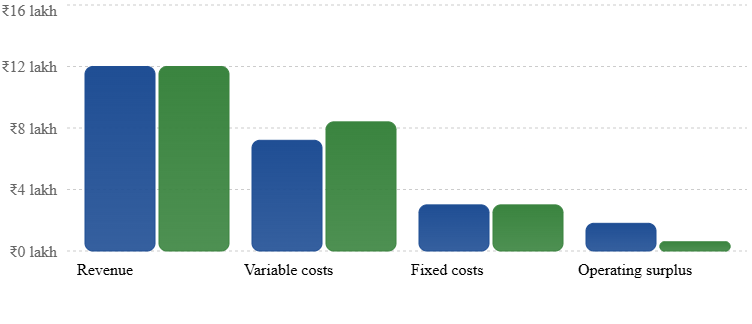
Expected monthly sales: ₹12 lakh from online consultations and follow-up services.
Variable costs and contribution margin: ₹7.2 lakh in variable costs, including doctor payouts, payment processing charges and consultation-related expenses, leaving a contribution of ₹4.8 lakh, or 40% of sales.
Fixed costs: ₹3 lakh per month, including technology maintenance, employee salaries, cloud infrastructure, marketing administration and customer support.
Break-even sales: ₹7.5 lakh per month, calculated as ₹3 lakh in fixed costs divided by the 40% contribution margin.
Telemedicine Business: Monthly Financial Analysis
Illustrative monthly revenue, variable costs, fixed costs and operating surplus in the base case and risk scenario. Amounts are in ₹ lakh.
■ Base case
■ Risk scenario
Risk scenario: Suppose higher doctor payouts and payment processing costs reduce the contribution margin from 40% to 30%. Monthly break-even sales then increase to ₹10 lakh:
Break-evensales=₹3lakh0.30=₹10lakh
At monthly sales of ₹12 lakh, the business would generate ₹3.6 lakh in contribution and retain ₹60,000 after the assumed fixed costs, before financing costs, taxes and other excluded expenses. This compares with ₹1.8 lakh remaining under the original assumptions.
Planning response: The business plan can recommend reviewing doctor payout agreements, tracking consultation volumes and repeat bookings, monitoring patient acquisition costs, negotiating payment processing charges and maintaining sufficient working capital to cover operating expenses during slower growth periods. It should also account for applicable telemedicine practice requirements, patient data protection and the credentials of participating healthcare professionals.
These controls help management evaluate operating margins and cash-flow risks but cannot guarantee a particular financial result.
Note: All figures in this example are illustrative assumptions for planning purposes, not actual Aviaan client results or industry benchmarks.
This worked example uses planning assumptions to demonstrate a telemedicine platform’s break-even calculation. These figures are not verified client results, official market statistics or a forecast for Hyderabad.
The calculation assumes the stated contribution margin remains consistent as sales change. Actual costs depend on the technology architecture, clinician payment terms, consultation mix and the cost of acquiring patients.
One key risk is higher patient acquisition costs combined with fewer completed consultations. If the contribution margin falls from 60% to 45%, break-even sales rise to ₹10,00,000 per month, calculated as ₹4,50,000 ÷ 0.45. At the assumed sales level, the platform would only cover its stated fixed costs.
The plan should test acquisition channels separately, monitor completed consultations rather than registrations alone, and connect technology spending to actual service usage. It should also examine provider availability and repeat bookings before expanding the platform or adding expensive features.
A telemedicine business plan is a document explaining a remote healthcare venture’s services, technology, clinical operations, target users and finances. It sets out investment requirements, revenue assumptions, staffing, compliance planning and risks for funding discussions, partnerships or internal decision-making.
Investment depends on whether you build a new platform or use existing software. Cost heads include development, hosting, security, integrations, clinical staffing, provider payments, legal and compliance advice, marketing, customer support and working capital.
Choose the clinical service and patient group, define the platform model and prepare a costed business plan. Establish appropriate provider arrangements, technology, patient workflows and privacy safeguards, then confirm applicable professional and regulatory requirements before launching.
A telemedicine business plan PDF can present the business model, operating plan and financial schedules in a shareable document. Check that the material reflects your service, technology costs, provider arrangements and target users rather than relying on generic market or revenue assumptions.
Yes. A sample or template can help organise the main sections, but its financial assumptions may not fit your platform. Replace them with your own development costs, clinician payments, pricing, acquisition expenses and realistic consultation volumes.
The plan can be adapted for virtual clinics, mobile health applications, remote patient monitoring, online therapy platforms, healthcare SaaS, tele-pharmacy services and AI-enabled healthcare products. Each model needs a distinct operating, revenue and compliance framework.
A carefully prepared telemedicine business plan connects the digital service, clinical workflows, technology investment and revenue model with realistic financial projections. It helps founders assess costs, prepare for funding discussions and plan the resources needed to operate responsibly. The plan should be built around documented inputs, applicable requirements and clear assumptions rather than guaranteed demand or approval.
Discuss your telemedicine business plan with Aviaan or email advisory@aviaanaccounting.com.




