Develop a comprehensive media business plan in India covering market research, target audience, industry trends, revenue models, marketing strategies, operational planning, and financial projections to support business growth and attract investors.
November 10, 2025
12 min read
COMMERCIAL EXCELLENCE
Loading...
Strategic guidance and institutional-grade solutions customized for your enterprise objectives.
Talk to a Financial Expert
Schedule a complimentary 30-minute discovery call to discuss your enterprise’s financial trajectory.
By submitting, you agree to our Privacy Policy.
Table of Contents
A strong media business plan turns a creative idea into a commercially workable business. Whether you are launching a digital marketing agency, social media management company, content studio, production house, digital publication, influencer management business or media consultancy, your plan should explain who you serve, how you earn revenue, what it costs to deliver your services, and how the business will achieve sustainable profitability.
Aviaan Accounting supports entrepreneurs and established businesses with market research, business strategy, financial projections, operational planning and funding-oriented business plans tailored to their objectives. A media business plan should reflect the economics of your specific model rather than rely on a generic template.
For a new media business, overall industry growth alone does not establish that a particular venture will succeed. A plan needs to define a target audience, identify paying customers, assess competitors and explain how the business will earn more than it spends.
Aviaan prepares business plans around a company's operating model, funding purpose and financial requirements. Explore our business plan in India to understand how a tailored plan can support your contracting business..
Aesthetic Clinic Market in India: Planning for Services, Costs and Demand
Market research should combine national industry evidence with local customer demand and direct competitor analysis. The right evidence depends on whether the proposed venture is an agency, publisher, production company, creator-led business or entertainment enterprise.
Use the following market factors as a practical research checklist.
Industry size: Establish the relevant market segment and avoid treating the entire media and entertainment sector as your addressable market.
Market growth: Review official or credible industry data, noting the period, definition and source.
Target customers: Identify customer types, business sizes, purchasing authority and likely budgets.
Customer demand: Validate demand through interviews, enquiries, tenders, competitor activity and pilot projects.
A professional media business plan helps founders, established agencies, production companies and investors assess the commercial requirements of a media venture. It connects service offerings, operating costs, client acquisition and financial projections in a structured document.
Financing requirements: Present startup costs, working capital needs, projected cash flow and repayment capacity when approaching a lender.
Investor and partner discussions: Explain the business model, target customers, revenue streams and growth objectives to potential investors or strategic partners.
Staffing and production budgets: Estimate recruitment costs, freelance expenses, software subscriptions and equipment requirements according to expected workloads.
Pricing and margin management: Assess whether retainer fees, project charges and production packages can cover direct costs and operating expenses.
Client concentration and payment risks: Evaluate the financial impact of delayed payments, seasonal demand, contract cancellations and the loss of major accounts.
A sector-specific plan provides a clearer basis for evaluating funding requirements, resource allocation and commercial priorities.
How to Write a Media Business Plan in India
Writing a media business plan in India requires a clear service model, evidence-based market assessment, defined operating procedures and financial projections linked to realistic sales and delivery assumptions.
Define the business concept: Specify whether the company will operate as a digital marketing agency, social media management firm, advertising agency, production studio or another media business.
Identify target customers: Define the industries, customer segments, geographic markets and client requirements the business intends to serve.
Establish the service and pricing model: Set out service packages, retainers, project fees, production charges and any licensing or commission income.
Assess the market and competition: Examine available official market indicators, customer demand, competing providers and the business's proposed positioning.
Develop the operational plan: Document staffing requirements, production workflows, technology, suppliers, quality controls and client management procedures.
Prepare financial projections: Calculate startup investment, revenue, direct costs, operating expenses, working capital, cash flow and break-even sales.
Write the executive summary: Summarise the business concept, target market, financial requirements, operating model and objectives after completing the supporting sections.
How Aviaan Can Help You Prepare a Media Business Plan
Aviaan is a business plan consulting firm that helps entrepreneurs and established businesses organise their commercial objectives, operating requirements and financial assumptions into a structured business plan. The scope can be tailored to the media company's business model and intended use.
Business plan preparation for decision-makers: Organise the business proposition, operating model and financial information for bank loan applications, investor discussions, partner reviews or internal planning.
Media-specific financial modelling: Develop projections covering client retainers, project revenue, staffing costs, freelance expenditure, equipment investment and working capital.
Finance-led planning approach: Connect operating assumptions with revenue forecasts, cash flow, funding requirements and break-even calculations.
Support across India: Coordinate business planning for clients in different locations, with Aviaan's India operations including its Belapur, Navi Mumbai office.
Our Simple 5-Step Process
Initial consultation: Discuss the media business, its services, current stage and the purpose of the plan.
Information collection: Gather pricing details, operating costs, customer assumptions, staffing plans and available financial records.
Plan and financial model development: Prepare the business plan and connect its commercial assumptions to the financial projections.
Review and refinement: Check the document for consistency, clarify assumptions and address information gaps.
Final business plan delivery: Present the completed document and supporting financial information in an agreed format.
A media business plan should cover the commercial, operational and financial requirements of the proposed venture, with sufficient detail to support its intended purpose.
Executive summary: Business concept, target customers, value proposition, funding requirements and objectives.
Company profile: Ownership, legal structure, location, services, management and development stage.
Market and customer assessment: Target segments, available market evidence, customer needs, competitor positioning and demand indicators.
Services, pricing and revenue model: Service packages, retainer agreements, project fees, production charges, licensing and other relevant income streams.
Marketing and sales plan: Brand positioning, lead generation, acquisition channels, conversion processes and client retention.
Operations and technology: Staffing, software, production equipment, suppliers, project workflows and quality control.
Management and organisation: Roles, required expertise, recruitment priorities and external professional support.
Compliance and risk management: Applicable registrations, contractual obligations, intellectual property permissions, content-related requirements and risk controls.
Financial projections: Startup investment, revenue, direct costs, operating expenses, working capital, cash flow, profit and loss, balance sheet where relevant, break-even and repayment assumptions.
Implementation and monitoring: Responsibilities, operational milestones, funding allocation and performance indicators.
Businesses preparing a social media agency business plan or a video production company business plan should tailor these sections to their services, equipment requirements, staffing structure and revenue model.
Case Study — Developing a Media Business Plan with Aviaan
Drawn from Aviaan's construction business planning work . Client names and details changed to protect confidentiality.
Problem
A growing media business in India wanted to expand its services from social media management and content production into digital advertising, video production and integrated marketing campaigns. The owners needed a business plan to support a funding application and demonstrate how the business could manage operating expenses, acquire clients and scale its service offerings.
Their existing estimates focused mainly on monthly client retainers and project fees but did not fully account for freelance production costs, software subscriptions, equipment investments, employee salaries, client payment delays or fluctuations in project demand. The owners needed a financial model showing service-level profitability, monthly cash flow, break-even revenue and the additional funding required to support expansion.
Solution
Aviaan structured the business plan around media services, including social media management, content creation, video production and digital advertising, identifying target customer segments, pricing models and operating requirements.
We developed service-costing estimates covering employee salaries, freelance designers and editors, production equipment, software subscriptions, advertising operations and administrative expenses.
We prepared a working capital schedule connecting monthly retainers, project-based billing, advance payments, supplier expenses and outstanding client invoices.
We modelled changes in client acquisition, project volumes, service pricing and operating costs to assess how fluctuations in demand could affect profitability and monthly cash flow.
We prepared projected profit and loss statements, cash flow, balance sheets, break-even calculations and debt repayment schedules to support the proposed funding application.
Result
The completed business plan and financial model provided a structured view of the proposed expansion, expected service economics and funding requirements. The financial analysis highlighted the importance of tracking profitability by service line, retaining recurring clients, controlling production costs and maintaining sufficient working capital to manage delayed client payments.
The business could use the plan to evaluate its expansion costs, determine the revenue needed to cover operating expenses and present its financial assumptions consistently during funding discussions. Any lending or investment decision would remain with the relevant financier or investor.
Real-World Example: Planning a Media Business in Mumbai
Here is a worked example for an entrepreneur expanding a media business in Mumbai, offering social media management, content production, video editing and digital advertising services. These are sample numbers, not a forecast.
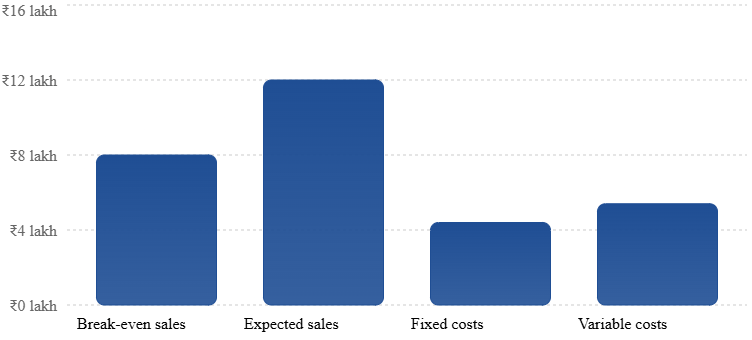
Expected monthly sales: ₹12 lakh from recurring client retainers and completed media projects.
Variable costs and contribution margin: ₹5.4 lakh in direct service-delivery costs, including freelance support, production expenses and project-specific resources, leaving a contribution of ₹6.6 lakh, or 55% of sales.
Fixed costs: ₹4.4 lakh per month, including employee salaries, office rent, software subscriptions, equipment expenses, insurance and administration.
Break-even sales: ₹8 lakh per month, calculated as ₹4.4 lakh in fixed costs divided by the 55% contribution margin.
Media Business: Break-Even Analysis
Monthly Revenue and Break-Even Comparison
Illustrative monthly figures for a media business, in ₹ lakh.
Risk scenario: Suppose increased freelancer rates, higher production expenses and competitive pricing reduce the contribution margin from 55% to 45%. Monthly break-even sales then increase to approximately ₹9.78 lakh.
Break-evensales=₹4.4lakh0.45₹9.78lakh
At monthly sales of ₹12 lakh, the business would generate ₹5.4 lakh in contribution and retain ₹1 lakh after the assumed fixed costs, before financing costs, taxes and other excluded expenses. This compares with ₹2.2 lakh remaining under the original assumptions.
Planning response: The business plan can recommend reviewing pricing before accepting projects, tracking profitability by client and service line, securing advance or milestone payments, negotiating recurring retainers and setting minimum contribution requirements for new projects. These controls help management evaluate profitability and cash-flow risks but cannot guarantee a particular financial result.
Note: This example assumes that client advertising spend is billed separately or excluded from reported service revenue and costs. Actual accounting treatment and financial projections would depend on the business's operating model.
Frequently Asked Questions
What is a media business plan?
A media business plan explains a media venture’s target audience, services, revenue model, competition, operations, marketing strategy, financial projections and risks. It helps founders assess viability and communicate their strategy to potential funders or business partners.
What should a digital marketing agency business plan include?
It should cover target customers, service packages, pricing, sales channels, staffing, software, delivery costs, client retention, cash flow and financial projections. The plan should connect expected sales to realistic team capacity and delivery margins.
How do I write a social media marketing agency business plan?
Define a niche, specify services and deliverables, research competitors, set pricing, plan client acquisition, estimate staffing and production costs, and forecast revenue and cash flow. Include measures for retention, utilisation, account profitability and client concentration.
Is a social media marketing plan the same as a business plan?
No. A social media marketing plan focuses on campaign objectives, audiences, channels, content and measurement. A business plan covers the wider company, including its business model, operations, finances, risks and growth strategy.
Can Aviaan prepare a media business plan for investors?
Aviaan can discuss a business plan tailored to the intended audience and requirements. The work may include market research, strategy, operating plans and financial projections. Funding decisions depend on the investor or lender and the evidence presented.
How much does a media business plan cost?
The fee depends on the business model, research requirements, financial complexity, number of revenue streams and intended use. A quote should follow a discussion of the scope and information needed for the engagement
Conclusion
A well-structured media business plan helps entrepreneurs in India assess market demand, define profitable service offerings, manage operating costs and establish realistic financial projections. Whether you are launching a digital marketing agency, content studio or production company, a tailored plan can support funding discussions, expansion decisions and long-term business planning. Aviaan helps translate your business objectives into a structured plan aligned with your operating model and financial requirements.
Partner with Aviaan Advisory today to unlock your business’s full potential. Our team of experts is here to provide tailored solutions and guide you every step of the way.